My book Why Religions Work explores religious tolerance issues. It could not be more relevant at the moment with the world in its present state.
This blog has concentrated recently on the wonderful pilgrimages I have been on - to the Holy Land and to Turkey and more recently to Holy Georgia , Greece "In the Steps of St Paul" , Ethiopia and most recently my experiences in Iran.

"If I was allowed another life I would go to all the places of God's Earth. What better way to worship God than to look on all his works?" from The Chains of Heaven: an Ethiopian Romance Philip Marsden

Thursday, 14 January 2016

The Fasil Ghebbi compound in Gondar


The Egg Building in the Fasil Ghebbi compound Gondar


We are on a Christian pilgrimage to Ethiopia with McCabe Pilgrimages. To quote from their website, "as pilgrims, we travel to discover more about our world, the peoples who inhabit it and the faith which shapes our understanding of life."

the fireplace separating male and female rooms and note
the holes for horns to hang meat
In Ethiopia, we are discovering more about the largest Oriental Orthodox church in the world today… and as with all McCabe pilgrimages, we try to engage with the local Christian community and return home with fresh insights into our own faith, enriched by all that we have experienced as we journey together.

one of the lions' cages
We are nearing the end of our visit to this fabulous country, and have already enjoyed many extraordinary experiences. But we still look forward to much more. Today, after visiting Debre Birhan Selassie (or Mountain of the Enlightened Trinity) we visit the Royal Enclosure or Fasil Ghebbi compound in Gondar, a UNESCO World Heritage Site since 1979, enclosing six castles and related buildings over an area of 70,000 square metres in the heart of the city. This is a great fortress-city, residence of its founder the Ethiopian emperor Fasilides and his successors.

The Emperor was tired of the pattern of migration that had characterised the lifestyle of so many of his forefathers, so he moved his capital here in 1636 AD. It is a photographer and tourist paradise, with great historical significance, as well as a place where locals also like to come to stroll and relax in a green haven of peace away from the city bustle and noise just the other side of its high stone walls.
The locals call the first castle we come to the Egg Building, because of the domed tops of its watchtowers. Inside the main hall is split into two, segregating the men and the women, sharing only a fireplace built into the wall between the two rooms. We are shown holes in the wall where meat was hung on horns because metal hooks would spoil the flavour. These horns are also seen in the Turkish Baths on the site, in this case used to hang clothes.

horn hooks for clothes in the Turkish Baths
Three of the castles are interconnected by trenches. We see the so called Window of Love, where the Emperor and his wife would apparently like to sit enjoying the pleasant view to the bridge and the people going about their business outside the castle.

A beehive high up in a tree is wrapped in savannah grass to protect it from the rain. Honey is introduced to attract bees and there can be as many as four harvests in one year if conditions are favourable.

the Mentewab Castle
We also see the old lion cages - where the poor beasts were kept until as recently as the 1960s - some guidebooks say the 1990s - to entertain the residents of the castles and their guests. There are stables and a stable yard to accommodate the horses of guests as well, and a banquet hall.
The sixth and last castle we visit was the only one commissioned by a female, Empress Mentewab, acting as regent for her young son, Iyasu II. It is the most impressive and well preserved of them all, decorated on the outside with Gondarine crosses. We can only view from outside the gates - we are not allowed near. 
entrance to the King's Baths

the channel to fill the King's Baths
We drive back through the town towards the King's Baths, also attributed to the same Emperor, and the site we are told of one of the best Epiphany festivals of the Ethiopian Orthodox Church. Here 10,000 or more pilgrims will gather annually and the huge reservoir is filled up from the local river for this occasion. It takes a month to fill. The Ark of the Covenant is brought from the local church in procession and the water is blessed. Everyone will try to be sprinkled with this Holy water, and many will swim in the water as well. There is song, dance, and a great mixture of religious and secular activity. Having experienced the recent festival in Lalibela we can well imagine what an incredible sight this must be. Scaffolding is erected at the far end of the bath for tourists - everyone else has to join the milling crowds, no doubt many climbing any available trees for better views of the activities. Johannes tells us that this festival of Epiphany is also a traditional time for dating. Boys would buy lemons and throw them at the girl of their fancy. If she picks it up he knows he is in with a chance. Nowadays, he says, they expect Apple iPods!!

the King's Baths
It's been a full day 
and tiring. 
But we somehow find the energy at the Four Sisters restaurant to join in the dancing around the tables with the curious shoulder, neck and arm movements - even somehow employing bosoms and hips - which seem quite unique to Ethiopia. The dancers display incredible energy and flexibility which we cannot hope to achieve so soon in our stay - although some of us have a reasonable attempt in a day or so in a night club in Bahir Dar! Dancing and entertainment is good enough reason to come to this restaurant if you are in Gondar, but the food is also fabulous - many different traditional Ethiopian dishes, alongside some more westernised offerings, all very well labelled and very veggie friendly - and as much as you can eat - come and come again style. It was a very good evening out, a great way to unwind and relax after what have been some very full days.


The sun sets over Mayleko Lodge. Tomorrow is Sunday and we will return to the church we saw today to experience a service Ethiopian Orthodox style…

Wednesday, 13 January 2016

Atheism in religious education - Why I will not sign the petition

Every three days at the moment I am using this blog to post about the continuing story of our Ethiopian pilgrimage. If you came to the site expecting that, you only have to wait until tomorrow for the next episode. But I hope you will read on…

As I struggled to open a new DVD packet I wondered why it had to be so difficult to gain access through all the cellophane and stickers. Cynically perhaps, I thought this may be an anti-theft device. But then am I so wrong? We seem to be living increasingly in a dishonest world - where the prevailing attitude seems to be that if we can get away with it, then why not. Shop lifting statistics are appalling. I see petty pilfering all around me. Without the cellophane I assume the fear is that someone would remove the DVD in the shop and walk out with it without paying. 
Where the Ark of the Covenant holding the
Ten Commandments is reputedly kept in Axum

I was brought up in a Christian culture and household, I learnt the Ten Commandments by heart and knew that it was wrong to steal. It would never ever have occurred to me to take anything from any shop on the long walk from the school through the town to the school bus. Now our local town has to impose a rule: no more than two students in the shop at any time and all bags to be left outside. I find that shocking. "Thou shalt not steal" still guides my life - that and all the other Commandments too. But that is not what I see all around me. What has happened to basic morality? A morality that has been grounded in religious values for so many years.

I have just been asked to sign a petition to tell Nicky Morgan to teach humanism and atheism as part of religious education in British schools. I won't. Whatever the November 2015 High Court judgment and the subsequent Department for Education statement say, religious education should be about - guess what - religion, in the same way that history lessons should teach history, science lessons teach science, and so on.

Worship Ethiopian Orthodox style
The organisation American Atheists says on its website that "the only common thread that ties all atheists together is a lack of belief in gods and supernatural beings." They stress that it is not a belief system, or a disbelief in gods or a denial of gods, neither is it a religion. Why therefore should it be included in Religious Studies. There is no place for it there - indeed nothing to teach about it.

When we teach about different religions, we teach about understanding those different religions, including the moral values which they support. And only with understanding can we foster respect. And I do not see that respect for religious beliefs from where I am sitting - it is certainly lacking among some of the new angry militant atheists who are anything but neutral and seem to argue their non-beliefs in their own fundamentalist way, almost like a new "religion." And an irreligious society does not seem to have served our moral and ethical values too well.

All of this is behind why I wrote Why Religions Work. The title could have been Why Religions Matter - because that is part of my story, and a very important one. Religions are social capital writ large, in many different ways. But there is a subtler more spiritual and transcendent message in the book which is not always being picked up on by the readers and in reviews. And that is a shame.
Because whether we like it or not we are all spiritual animals. And if we share a common spirit, then the religions have so much more in common, share so much more than is often given credit for - and this I believe is a key to interfaith harmony.

Debre Birhan Selassie
church wall paintings Ethiopia  
Of one thing I am sure. There is simply not enough respect for religions, particularly in the Western world. In writing Why Religions Work I wanted to make a serious contribution to understanding why we all need to support religion as well as spirituality. Further, I wanted to explore how a global spiritual awareness, an appreciation of spiritual human inter-connectivity and therefore shared responsibilities, may help; why different ideas of spirituality, alongside advances in the scientific understanding of empathy and consciousness, may be closing the gap between science and religion, between spirituality and religion, perhaps even helping to forge a clearer path towards better inter- religious and inter-denominational understanding; and why this matters for the future of our world.

We need spirituality. And we need religions. We need them both very much indeed. And there is nothing to teach about atheism in a class on religions. So I will not sign that petition.


Monday, 11 January 2016

Built to house the Ark of the Covenant - Debre Birhan Selassie

Heavily laden donkeys on way to market 

Airport Ethiopian style at Lalibela
 It is Saturday, market day, in Lalibela, and we are set to fly to Gondar, the "Camelot of Africa", famous for its medieval castles and churches. In particular we will enjoy a tour of the Royal Enclosure of Fasil Ghebbi and the most incredibly beautiful church interior.

cattle on way to market
As our coach makes its way along the twisting road towards the airport we pass swarms of people and animals walking in both directions, to and from the market. This is subsistence living. People sell to buy what they need most in that moment, be it food or fuel or clothes or animals. But market is about much more than that. Johannes tells us that the market is also a place to spot stolen goods, to find and court the girls, to find mediators to settle disputes of all kinds, and simply for communication, the oil of human relationship and society.

entrance to the church
The federal police check our visas at the airport perimeter, then all our bags go through security screening at the entrance into the building and we go through the usual full security search ourselves after check in to go through to departures. In the light of the awful Paris terrorist attack that we have just heard about this all seems very essential. There was a French party at our hotel last night in Lalibela and they were visibly and justifiably distressed by the news back home. 

I wrote in my diary for the day: "Jesus wept. God must be weeping".

Icons of Holy Trinity and Crucifixion
above the Holy of  Holies entrance 
Mayleko Lodge hotel - lovely
"Jesus wept" - John 11: v. 35 - the shortest verse in the Bible, with a load of significance. Jesus wept because of his humanity, weeping with those who weep, because he is full of love for mankind. How he must weep now.

It is a very short flight from Lalibela to Gondar and soon we are back in a coach for the 10 minute drive to our hotel - Mayleko Lodge - I had worried about this - thinking of Gatwick and Heathrow and flight paths and noise! But I didn't have to. There are only a couple or so flights a day it seems - and the planes are small anyway and quiet. And the hotel is fabulous! We all have our own cottages - in the traditional local thatched style, with huge rooms, spotlessly clean and with all mod cons. including huge walk-in showers (Just use the water for a shower when it is available - like much of Ethiopia water is scarce and the supply temperamental) and massive balconies where we can soak up the sunshine and the view. And it is hot. A few take advantage of the short while available before lunch to enjoy a swim in the pool. The birdlife here is super - we are surrounded by birdsong in pretty gardens with different coloured hibiscus lining the paths leading up to the pool and the restaurant at the top of the site, which affords great views over the countryside.
vultures outside the church
wall paintings

Soon we are back in the coach for our first attraction of the day - Debre Birhan Selassie (or Mountain of the Enlightened Trinity) - the only church in Gondar which escaped the 1888 Mahdist invasion from the Sudan unscathed - legend tells us that an angry swarm of bees intervened to keep the soldiers back, with the help of the Archangel Michael holding a flaming sword. All the other churches in the city were torched. 

Debre Birhan Selassie
This church is incredible for the beautiful eighteenth paintings that totally adorn its inner walls and ceiling. 

school books for sale on Gondar pavement
They variously represent the Life of Christ, the lives of early Christian saints and their rather nasty martyrdoms - all watched over by hundreds of painted angels on the ceiling and arches. The church was built in the 1690s to the same dimensions as the Temple of Solomon in Jerusalem, reputedly to house the Ark of the Covenant when it was brought over to Ethiopia. We will visit the church again tomorrow, Sunday, to observe a service in progress. 

The street sights as we drive through Gondar are endlessly fascinating. Blue tuk tuks everywhere - hundreds are watching a boxing match in one of the large squares - street vendors everywhere - we even see our first motor car!! 


Friday, 8 January 2016

Asheton Mariam, Lalibela, Coffee and Lammergeiers


the pathway to Asheton Mariam

 I cannot believe how much we did today. 
deacons and drummers in service 
Two hours after being stimulated by the spiritual and physical experiences of feast day at Na'akuto La'ab monastery and church we have bumped our way up an incredibly rough road to the mountain top high above Lalibela and we find ourselves walking along the footpath high up above the valley to the church of Asheton Mariam sitting at 3200 metres. It is a lovely walk on a wide and safe path although at the start and at the top there are a few difficult uneven and steep steps to negotiate - always with willing local helpers who for the expectation of a small tip will help you negotiate the hazards, not always very expertly.

Priest proudly displays the Book of Miracle
of Mary in the church
Some of us are privileged to sit with the deacons chanting
the liturgy
Rocks piled high at the sides of the road up to the church wait for further road improvements but, intentionally or otherwise, serve as crash barriers meanwhile. The drop in places is scary!
view from path to Asheton Mariam
We look down to the town of Lalibela way below and see the impressive terracing where barley, wheat and tef are grown. There are also many eucalyptus trees, imported into the country and creating their own problems - they are thirsty and compete for valuable water. They also have shallow roots which contribute nothing to stabilizing the soil and preventing the very real problem of soil erosion.

a short section of the path was tricky
Once we arrive at Asheton Mariam the priest is very proud to show us the treasures of his church. First he holds the original cross of King Lalibela, followed by two rather special processional crosses, one depicting the 12 apostles with Christ in the middle. Other priceless items he shows us include a special 13th century several sided icon, a 15th century religious painting on goatskin, a 14th century beautifully illustrated book of the Miracle of St Mary. This is not well preserved but the organic colours are still brilliant, helped by the darkened interior of the church. It has a case made of cow/oxen skin which we are all allowed to feel!! Horror!

souvenirs for sale on path to Asheton Mariam
After all receiving an individual blessing from the priest, which is thorough and quite moving, we make our way back to the coach, many of us unable to resist the charming souvenirs being peddled by the equally enchanting children on the path going down. Before boarding the coach we are treated to an impromptu coffee brewed and served by a local lad al fresco - we perch on rocks around a piece of waste ground and the plastic mugs have certainly not been in a dish washer!

impromptu coffee at bottom of path to Asheton Mariam
We are soon back in Lalibela in the Seven Olives restaurant enjoying a well deserved and much needed rest and lunch. The spinach soup was excellent, as was the veggie spaghetti dish, although there was as ever far too much. Johannes then takes us to a more formal traditional coffee ceremony. This, he explains, is usually a very intimate community event - where many share coffee together in each other's homes in a social occasion that can last two hours or so - both during the week and especially after church, with gossip circulated, problems shared, news disseminated. These ceremonies start with a prayer and end with a family blessing, we are told. The grass strewn around the floor is for a fertility wish.
Supermarket Ethiopian style
We watch the lady roast the coffee beans, then grind them, boil them up and finally serve the freshly brewed and strong black drink into small and traditional cups. We are also offered an organic honey wine, with popcorn and a kind of crisp like pitta bread, before a glass of strong spirit - distilled using, variously, barley, wheat, sorghum, corn or hops. This is normally accompanied by toasts offered by different members of the gathered community, somewhat reminiscent of the toasting ceremonies or supra we learnt about on our pilgrimage to Caucasian Georgia. The brew is strong. All the while a Lammergeier or Bearded Vulture circles outside over the roof tops. We see quite a few of these during our trip.

at the coffee ceremony demonstration
We are now truly exhausted, and some of us perhaps even a little unsteady from generous spirit servings at our coffee ceremony, and really glad to return quite early to the hotel, soon after 3pm,  for rest and recuperation. Some sleep, I pack, before we convene for our evening prayer meeting which I lead this time. We then walk out locally for supper at the Lalibela Cultural Centre.
Tomorrow is another day - we are off to Gondar; a very different experience and a wonderful hotel as well.....

Tuesday, 5 January 2016

Feast Day in Lalibela at Na'akuto La'ab

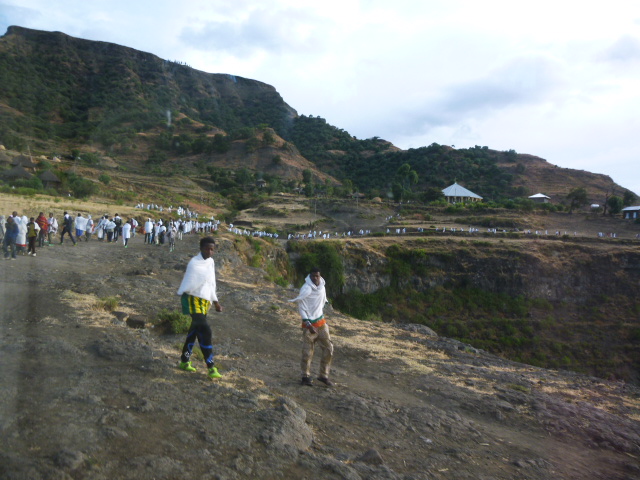
all the white clad pilgrims on the road on way to church
This was the most unusual day of the whole trip - something none of us had ever experienced before. And what an experience it was. Friday 13th November 2015 - (3 Hadar 2008 in the Ethiopian calendar) the third Ethiopian day of the third Ethiopian month and an important feast day for the Orthodox Christian community in Lalibela, so 
we change our itinerary in order that we can absorb for ourselves this extraordinary spiritual event.
the church inside the cave we are making our way to
I wrote in my diary for the day:
Overwhelming, spiritually, physically and mentally.
Frightening - the crush of people - tiny children in among it all - the policeman who looked after our shoes for us - the guns, batons and high security around the church entrance.
the crush on the path down to the
church
Ululating, the long high pitched and wavering sound, almost trilling, that comes out of the mouths of the priests and people. We heard it here in the church, from the priests, as they swayed in unison in a curious spiritual dance, and we would wake up later in the trip in the very early hours of the morning to hear the same sound as people made their way in the early dawn to a local church above our hotel in Gondar. Somehow or other the tongue and uvula together can create this sound. I wonder how long it takes to learn the technique? It is very much a feature of worship in the Ethiopian Orthodox Church.
resting on way to church - in background
Then there was the rhythmic music of the drums and the sistrum, shaken vigorously by the cantors as they danced, and the tall prayer sticks often used to keep that rhythm.

In fact all the emotions felt thoroughly assaulted by the end of our experience….
So much so that many of us felt very much in need of a strong coffee and a quiet place!   


pilgrims climb back from church in right
background
But I'm getting ahead of myself. As we drive from our hotel to the little cave church of Na'akuto La'ab about 6km south of Lalibela towards the airport, we are at once struck by the columns of people, nearly all dressed in their white gabbi or shama, the white cloths worn toga like by men and women respectively (Netela are similar but have brightly embroidered borders). All these men, women and children are streaming along the road as far as the eye can see, coming from every direction, all making their way towards the church, giving the appearance of a long white slow moving snake hugging the curves of the road into the distance. It is a 90 minute walk for them from Lalibela along the tarmac road. Many take short cuts across the countryside along what appear to be well worn pathways. Along the way we stop to buy candles from one of the many vendors plying their wares. We buy ours from a boy who is visually impaired, chosen by our guide, and it is good to support him in this small way.
taking time out by the side of the path
The little church we are making our way towards was built by Na'akuto La'ab, the nephew of King Lalibela and his successor, although as with many sites in Ethiopia there seem to be several conflicting traditions around his reign and the foundation of the church which bears his name. 
inside the cave, outside the church
The coach turns off the main road and we bump along for a short while on a rough track before disembarking to walk the rest of the way to the church. As we make our way down the rough track along the cliff edge we are jostled from all directions, and this is the only time on the whole trip when we are warned to keep valuables close to us. People all around us are going in our direction, but there are just as many coming back up the path, and there is no lane discipline! The services here carry on for a long time and people come and go as they please, it seems. Some simply go to receive a blessing. We are given dust - it may be charcoal - to mark a cross on our foreheads, reminiscent of our own Ash Wednesday service - "dust thou art and to dust thou shalt return" - this tradition originated in Old Testament times and ashes then as now symbolise mourning, mortality and penance. 


note man in orange - priest - holding
prayer staff
Somehow we all arrive through the crowds at the mouth of the cave and manage to fight our way inside! It's a struggle and somewhat frightening but we stay inside long enough to experience the ululating, the dance and the music. But very soon we are glad to force our way back out side away from the crush which was actually alarming for some of us who are not so tall. As I left, carefully sidestepping around a lady sitting on the floor, totally hidden from most of us in the heaving mass of the crowd, I was astonished to see she had a very small child hugging close in to the folds of her garment. I feel very sure that there must be some injuries in such a crush but we survived intact!
villagers gather at top of path to church

And we marvelled at the shoes strewn everywhere along the path to be found again after coming out of the church. We have to assume that as long as the men, women and children all find a pair that fit and perhaps are the right colour they are broadly happy. The shoes are mostly plastic flip flops or plastic sandals, mostly brightly coloured. There is no way they could hope to find the exact pair they started the day off with!!


A few links to further information:


Saturday, 2 January 2016

Lalibela rock hewn churches - the Southern cluster

view from Ben Abeba restaurant 
 We are on our way back from Yemrehane Christos monastery, 2700 metres up in beautiful isolation north east of Lalibela. We came by coach and climbed the 195 steps up through lovely Juniper forest to the monastery.
It is apparently possible to visit by mule from Lalibela, a 10-12 hour round trip if you feel inclined, or would be unable to manage the steps.
traditional coffee making at Ben Abeba
This afternoon we will be visiting the five churches in the second, South Eastern cluster, of Lalibela rock hewn churches. But first we have lunch at the extraordinary Ben Abeba restaurant high up atop a hill on the outskirts of Lalibela - a wonderful experience - excellent food, veggie friendly and hosted by the Scottish lady who set this up a few years ago with an Ethiopian business partner. It looks like a witch's hat as we approach, with a multi layered decking construction, surrounded by very pretty gardens with lots of different sitting out areas, and amazing views all around.   
The restaurant put on a fabulous buffet spread for our group at lunchtime.
I usually confine my restaurant reviews to Trip Adviser but this one is so special I think it deserves a mention here.
And so on to the churches.


Bet Giyorgis
Bet Giyorgis in its trench
with the priest inside Bet Giyorgis
We start with the totally iconic monolithic Bet Giyorgis - the church seen on all the publicity and tourist brochures for the area. It is for this reason, I guess, that it has escaped being covered by one of the rather hideous protective roof shelters which so obscure the views and photo opportunities of the other churches - but which are necessary to protect these extraordinary buildings from further decay. 
This church has been excavated out of the rock to a depth of 15 metres or so, in the shape of a cross, sitting in its own sunken courtyard with vertical walls. Dramatic from the outside, less so inside, but it has a great atmosphere if you are able to experience it between tour groups.

inside Bet Mercurios
From here we make our way to Bet Gebriel-Rafael, more like a fortress than a church, which we approach over a wooden walkway. Indeed, with Bet Mercurios, which we visit next, this may well have been first a fortified palace, perhaps carved originally as the palace for King Lalibela.

Bet Emanuel
The brave among us stoop to go through a pitch black tunnel from Bet Gebriel-Rafael to Bet Mercurios but there is an alternative route! However I would recommend braving the tunnel to gain the full atmosphere of the visit - the guides are well equipped with torches!Bet Mercurios has some wonderful fifteenth century wall paintings, as well as some iron shackles which indicate its possible early role as a prison. Saint Mercurios was a third century Coptic saint, tortured and beheaded for his Christian faith.


some of those steep and rocky steps
Some very steep steps take us down to the Bet Emanuel, the most elegant church of them all in Lalibela. Its appearance reminds us of the Yemrehane Christos monastery style of layered wood and stone.

Bet Abba Libanos
Finally we make our way to Bet Abba Libanos, built, legend tells us, by King Lalibela's wife in one night, with the assistance of angels. Sadly we are approaching closing time and our visit is rushed. The priest wants to go home and soon we are also making our way back to our hotel, for a prayer meeting and supper at the Lalibela Cultural Centre.


our shoes are well looked after and
ready for us with willing hand as well
pilgrims walk for miles, from all directions, to Na'akuto
La'ab for the feast day service
The next day is a special feast day at Na'akuto La'ab and we will see this at first hand - this will be an extraordinary experience and one certainly not to be missed - we will then go on to explore the mountain top church of Asheton Mariam at 3200 metres - even higher than we have been today - and join in the liturgy there. That also is a moving and spiritual experience for some of us.