My book Why Religions Work explores religious tolerance issues. It could not be more relevant at the moment with the world in its present state.
This blog has concentrated recently on the wonderful pilgrimages I have been on - to the Holy Land and to Turkey and more recently to Holy Georgia , Greece "In the Steps of St Paul" , Ethiopia and most recently my experiences in Iran.

"If I was allowed another life I would go to all the places of God's Earth. What better way to worship God than to look on all his works?" from The Chains of Heaven: an Ethiopian Romance Philip Marsden

Showing posts with label Asheton Mariam. Show all posts

Friday, 8 January 2016

Asheton Mariam, Lalibela, Coffee and Lammergeiers


the pathway to Asheton Mariam

 I cannot believe how much we did today. 
deacons and drummers in service 
Two hours after being stimulated by the spiritual and physical experiences of feast day at Na'akuto La'ab monastery and church we have bumped our way up an incredibly rough road to the mountain top high above Lalibela and we find ourselves walking along the footpath high up above the valley to the church of Asheton Mariam sitting at 3200 metres. It is a lovely walk on a wide and safe path although at the start and at the top there are a few difficult uneven and steep steps to negotiate - always with willing local helpers who for the expectation of a small tip will help you negotiate the hazards, not always very expertly.

Priest proudly displays the Book of Miracle
of Mary in the church
Some of us are privileged to sit with the deacons chanting
the liturgy
Rocks piled high at the sides of the road up to the church wait for further road improvements but, intentionally or otherwise, serve as crash barriers meanwhile. The drop in places is scary!
view from path to Asheton Mariam
We look down to the town of Lalibela way below and see the impressive terracing where barley, wheat and tef are grown. There are also many eucalyptus trees, imported into the country and creating their own problems - they are thirsty and compete for valuable water. They also have shallow roots which contribute nothing to stabilizing the soil and preventing the very real problem of soil erosion.

a short section of the path was tricky
Once we arrive at Asheton Mariam the priest is very proud to show us the treasures of his church. First he holds the original cross of King Lalibela, followed by two rather special processional crosses, one depicting the 12 apostles with Christ in the middle. Other priceless items he shows us include a special 13th century several sided icon, a 15th century religious painting on goatskin, a 14th century beautifully illustrated book of the Miracle of St Mary. This is not well preserved but the organic colours are still brilliant, helped by the darkened interior of the church. It has a case made of cow/oxen skin which we are all allowed to feel!! Horror!

souvenirs for sale on path to Asheton Mariam
After all receiving an individual blessing from the priest, which is thorough and quite moving, we make our way back to the coach, many of us unable to resist the charming souvenirs being peddled by the equally enchanting children on the path going down. Before boarding the coach we are treated to an impromptu coffee brewed and served by a local lad al fresco - we perch on rocks around a piece of waste ground and the plastic mugs have certainly not been in a dish washer!

impromptu coffee at bottom of path to Asheton Mariam
We are soon back in Lalibela in the Seven Olives restaurant enjoying a well deserved and much needed rest and lunch. The spinach soup was excellent, as was the veggie spaghetti dish, although there was as ever far too much. Johannes then takes us to a more formal traditional coffee ceremony. This, he explains, is usually a very intimate community event - where many share coffee together in each other's homes in a social occasion that can last two hours or so - both during the week and especially after church, with gossip circulated, problems shared, news disseminated. These ceremonies start with a prayer and end with a family blessing, we are told. The grass strewn around the floor is for a fertility wish.
Supermarket Ethiopian style
We watch the lady roast the coffee beans, then grind them, boil them up and finally serve the freshly brewed and strong black drink into small and traditional cups. We are also offered an organic honey wine, with popcorn and a kind of crisp like pitta bread, before a glass of strong spirit - distilled using, variously, barley, wheat, sorghum, corn or hops. This is normally accompanied by toasts offered by different members of the gathered community, somewhat reminiscent of the toasting ceremonies or supra we learnt about on our pilgrimage to Caucasian Georgia. The brew is strong. All the while a Lammergeier or Bearded Vulture circles outside over the roof tops. We see quite a few of these during our trip.

at the coffee ceremony demonstration
We are now truly exhausted, and some of us perhaps even a little unsteady from generous spirit servings at our coffee ceremony, and really glad to return quite early to the hotel, soon after 3pm,  for rest and recuperation. Some sleep, I pack, before we convene for our evening prayer meeting which I lead this time. We then walk out locally for supper at the Lalibela Cultural Centre.
Tomorrow is another day - we are off to Gondar; a very different experience and a wonderful hotel as well.....

Saturday, 2 January 2016

Lalibela rock hewn churches - the Southern cluster

view from Ben Abeba restaurant 
 We are on our way back from Yemrehane Christos monastery, 2700 metres up in beautiful isolation north east of Lalibela. We came by coach and climbed the 195 steps up through lovely Juniper forest to the monastery.
It is apparently possible to visit by mule from Lalibela, a 10-12 hour round trip if you feel inclined, or would be unable to manage the steps.
traditional coffee making at Ben Abeba
This afternoon we will be visiting the five churches in the second, South Eastern cluster, of Lalibela rock hewn churches. But first we have lunch at the extraordinary Ben Abeba restaurant high up atop a hill on the outskirts of Lalibela - a wonderful experience - excellent food, veggie friendly and hosted by the Scottish lady who set this up a few years ago with an Ethiopian business partner. It looks like a witch's hat as we approach, with a multi layered decking construction, surrounded by very pretty gardens with lots of different sitting out areas, and amazing views all around.   
The restaurant put on a fabulous buffet spread for our group at lunchtime.
I usually confine my restaurant reviews to Trip Adviser but this one is so special I think it deserves a mention here.
And so on to the churches.


Bet Giyorgis
Bet Giyorgis in its trench
with the priest inside Bet Giyorgis
We start with the totally iconic monolithic Bet Giyorgis - the church seen on all the publicity and tourist brochures for the area. It is for this reason, I guess, that it has escaped being covered by one of the rather hideous protective roof shelters which so obscure the views and photo opportunities of the other churches - but which are necessary to protect these extraordinary buildings from further decay. 
This church has been excavated out of the rock to a depth of 15 metres or so, in the shape of a cross, sitting in its own sunken courtyard with vertical walls. Dramatic from the outside, less so inside, but it has a great atmosphere if you are able to experience it between tour groups.

inside Bet Mercurios
From here we make our way to Bet Gebriel-Rafael, more like a fortress than a church, which we approach over a wooden walkway. Indeed, with Bet Mercurios, which we visit next, this may well have been first a fortified palace, perhaps carved originally as the palace for King Lalibela.

Bet Emanuel
The brave among us stoop to go through a pitch black tunnel from Bet Gebriel-Rafael to Bet Mercurios but there is an alternative route! However I would recommend braving the tunnel to gain the full atmosphere of the visit - the guides are well equipped with torches!Bet Mercurios has some wonderful fifteenth century wall paintings, as well as some iron shackles which indicate its possible early role as a prison. Saint Mercurios was a third century Coptic saint, tortured and beheaded for his Christian faith.


some of those steep and rocky steps
Some very steep steps take us down to the Bet Emanuel, the most elegant church of them all in Lalibela. Its appearance reminds us of the Yemrehane Christos monastery style of layered wood and stone.

Bet Abba Libanos
Finally we make our way to Bet Abba Libanos, built, legend tells us, by King Lalibela's wife in one night, with the assistance of angels. Sadly we are approaching closing time and our visit is rushed. The priest wants to go home and soon we are also making our way back to our hotel, for a prayer meeting and supper at the Lalibela Cultural Centre.


our shoes are well looked after and
ready for us with willing hand as well
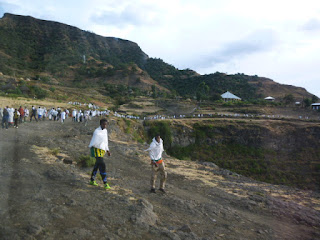
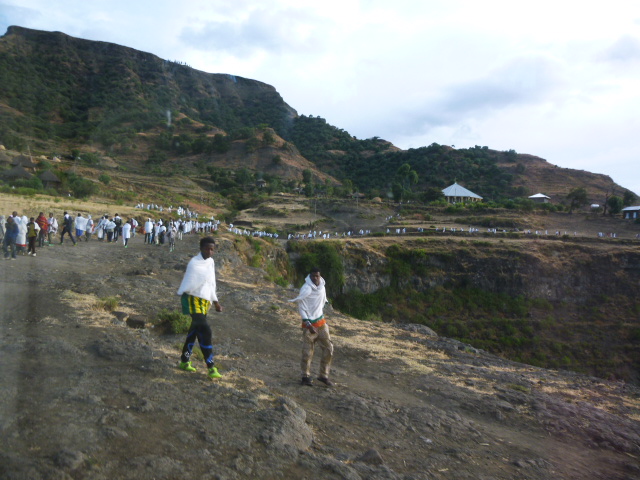
pilgrims walk for miles, from all directions, to Na'akuto
La'ab for the feast day service
The next day is a special feast day at Na'akuto La'ab and we will see this at first hand - this will be an extraordinary experience and one certainly not to be missed - we will then go on to explore the mountain top church of Asheton Mariam at 3200 metres - even higher than we have been today - and join in the liturgy there. That also is a moving and spiritual experience for some of us.