My book Why Religions Work explores religious tolerance issues. It could not be more relevant at the moment with the world in its present state.
This blog has concentrated recently on the wonderful pilgrimages I have been on - to the Holy Land and to Turkey and more recently to Holy Georgia , Greece "In the Steps of St Paul" , Ethiopia and most recently my experiences in Iran.

"If I was allowed another life I would go to all the places of God's Earth. What better way to worship God than to look on all his works?" from The Chains of Heaven: an Ethiopian Romance Philip Marsden

Monday, 16 November 2015

Our journey through Greece continues - Delphi - where man is closest to God


cone marking the centre of Delphi


We are following in the steps of St Paul on his second missionary journey through Greece. As we drive towards Athens from Thessaloniki we have some diversions from Paul's route along the way, one of which is Delphi


The reconstructed Athenian Treasury
Leaving the amazing Meteora Monasteries behind us we now have two mountains and many smaller roads to traverse before we reach Delphi so we settle for the long drive. There are really fabulous views now. The scenery is simply stunning up here. There are green meadow clearings far below us in the valley but not the lush rain drenched vegetation of say Austria or Georgia. These are of a more sombre hue.There is also plenty of mining activity, huge machines extracting the red sandstone for the road building going on around us. A small vineyard clings precariously to the side of the upper slopes on the other side of the valley. A small waterfall gushes out of the rocks by the side of the road. We see wind farms marching across the mountain peaks.
Delphi, we are told, unlike Olympia which was just for the Greeks, was there for everyone to get answers from their gods. Dating back into prehistory, and featuring prominently in the ancient Greek myths, here was for many centuries the cultural and religious centre of the Hellenic world. It is here that two eagles sent out in opposite directions by Zeus on a mission to find the centre of the world finally met. The site was sacred to Gaia or Mother Earth and guarded by Python, the terrible serpent. Apollo later killed Python and the Cretans, arriving at Kirrha, the port of Delphi, with Apollo disguised as a dolphin, built Apollo's Sanctuary. 
 
With 25 km to go to Delphi according to the signpost, we come down the last slopes of the Parnassos mountain range with small family Bed and Breakfasts all around us, catering for the skiing tourists who visit in winter - there are some very charming ski resorts here.  We descend into the massive olive groves now stretching into the distance on either side of the road, tall cypress trees standing out above the olive trees like dark sentinels. The olives are Amfisa - having a particular colour from the way they are cured. The Corinthian Sea can be glimpsed down to our right.
So we arrive at Delphi - seemingly clinging to the edge of the cliff on the lower slopes of Mount Parnassos
Delphi is a totally enchanting site and I am captivated. 
The fourth century theatre
No wonder it is one of the most popular places on the tourist trail in Greece and sometimes described as the most attractive Greek classical site. Delphi was regarded as the centre of the world by the ancient Greeks and is deeply engraved on the record of Greek history, being a place of incalculable religious and political importance, attracting pilgrims from all over the Hellenic world. Here the Oracle was consulted by both states and individuals. 
This was the religious background against which Paul was preaching the Christian gospel. 
After lunch in a local restaurant we head for the excellent museum where priceless artefacts from the site are preserved with excellent detailed explanations including English and French translations as well. We see the world famous bronze Charioteer, the wonderful frieze from the Siphnian Treasury, the larger than life-size statues of the Twins of Argos, beautiful gold and ivory jewellery and statuettes, and much, much more. The museum shop is sadly closed so those of us who still like to buy souvenirs and glossy booklets. 

Looking down onto the Apollo Temple and scenery beyond
There is so much to see here and we couldn't possibly see everything. There is an excellent write-up on Delphi here. I would love to come again on my own and take it all in at my own pace. Climbing down the path back to the coach I see a small group of visitors cross legged in the shade meditating - what a place for this - I would have loved to join them but our time table does not allow for any more time here and we are soon back in the coach settling down for the two and a half to three hours drive ahead to Athens. The coach is very quiet - we are all very weary and perhaps also in different ways touched by the atmosphere and the spirit of Delphi!
Doric columns of the Temple

We see glimpses of God everywhere - I certainly find God in all this great beauty - in the sunsets, the churches and their beautiful frescoes etc - but we have to surrender ourselves to feel in touch with the transcendent - Socrates was in touch with this all the time and Jesus himself was a mystic. 


Now driving Eastwards towards Athens, the Bay of Corinth far to our right, Mara tells us there are 9 million olive trees here in the vastest of olive groves imaginable, while Mark reminds us that Athens is of course the spiritual home of ancient philosophy - still so important in guiding the way we live and flourish, through rational argument and debate. We are reminded that Paul was born into this background and both he and Jesus were Hellenic Jews, influenced as much by that as by being Jewish. 
panoramic view of theatre


Friday, 13 November 2015

Travelling through Greece - in the Steps of St Paul - on our way to Athens


We are off to Delphi today. Before breakfast I stroll around the hotel garden and find some more of those curious cocoons in pine trees that I have spotted all along our route. Up until now I have not been able to get a decent photo. Now I have the photo I rather wish I hadn't tried to identify these online. It seems they are rather nasty and I am lucky to have escaped without an allergic reaction at worst and at best some pretty horrible itching!
There is lots more information here. It's rather creepy!

We retrace our steps from yesterday through Trikala driving through the plain of Thessaloniki with mountains in the distance on both sides. Many of the houses appear to be half finished. One could easily assume that this is because of the financial problems- used as we are to half built hotels and houses in tourist areas of Europe which have been started in better times and since abandoned. But no; much of this is apparently due to the traditional Greek family culture - as girls in the family marry another floor is completed and they live with the family as the aging parents move to the lower floor - seems to make a great deal of sense to me- and I understand that planning and tax implications are also a consideration.
We also see a huge gypsy camp - these people travel according to the seasons and the work thus offered. They are paid in cash and kind - fruit and vegetable which they can then sell for profit - always very fresh and cheap and a good buy. These Nomads have no negative association here, Mara tells us.


They have to serve their term in the army and pay their taxes just like any other Greek. It was, she tells us, the huge influx of gypsies from the Balkans in the 1990s that have given a bad name to all travellers here. The true nomads, we are told, are a fascinating people with a religion that is an amalgam from many different traditions.
a nomad camp
Now instead of driving back Eastwards to the main coastal road we cut south towards Lamia across a high plateau through the mountains. Unusually for this area I spy a field of sunflowers - amazing how they turn their heads around to follow the daily travel of the sun across the sky. It feels like Tuscany!

Another nomad settlement we pass is empty - they are all out of camp at present picking water melons. Four km from the ancient city of Lamia - originally dating back at least to the bronze Age - we see the Aegean sea again - twinkling brightly in strong sunshine - and the high mountain of Bralos ahead.

We stop at Thermopiles for a comfort break. I am lucky to be at the front of the queue for a cappuchino and donut for 5 euro. The toilets everywhere are very clean - even the fortunately rare squat type. We settle down for another 2 hour drive to Delphi - it doesn't look far on the map but we will go over two mountains and on smaller roads - so we look forward to a beautiful route.

And we are not disappointed. There is plenty of Cotinus - the lovely pink fluffy flowers on roadside shrubs - and trees with red/brown pods all over them - looking like dead leaves or branches. In fact these are seed pods, the tree I guess a legume judging by the leaves and pods - but I havn't identified this as yet. 


Delphi

And so we arrive in Delphi...

Tuesday, 10 November 2015

Travelling Through Greece - Icons


We have feasted our eyes and spirits on the amazing views and monasteries of the Meteora mountains and now we head south in the coach to Trikala - the far mountains in their purple and blue haze contrasting with the orange roofs, green sweet corn crops and golden straw drying in the fierce sun in the nearer lowlands. 
Everywhere pylons and telegraph poles and wires criss-cross the landscape making photography difficult. We pass by big marble yards - there are several grains of marble to work with for different purposes - small grain are for delicate sculptures etc, large grains are for working tops and cemeteries - there is sadly a big market in the roadside shrines.
We are going to visit one of the most important iconographers in Greece - to an icon workshop - where the skill has been passed down through the generations and it is still very much family run. Now those who want to follow the art have to go to art school and obtain a licence to produce them. Traditionally the artist prayed as he painted - now those fresh from Icon art school are less likely to be so religious. In amongst the shops selling lighting and cars - a Mercedes Benz showroom, with servicing and elf petrol, a most unprepossessing entrance gives no clue to what we will find inside. 
We go through a nondescript entrance door to climb a cool wide marble staircase and so into the showroom where we are offered Greek Delight (like Turkish Delight but better, we are told!) - and plentiful freshly brewed coffee and water - all most welcome. It is very hot in the workshop where we are led - but the demonstration of how the icons are prepared ready for painting is fascinating.
Local wood is seasoned over 3 years - cedar, pine, walnut - olive (hardest of all) and beech. We saw how cotton is stretched on the frame with a glue mix to fasten layers - then to kiln - and finally smoothed with sandpaper for painting.
Then we go into the part of the shop where the icons are displayed, and there are three people sitting at easels painting them - and signing the backs of those we purchased - Who could not resist at least one - these seem very superior to those we have already purchased along the way. They are all truly beautiful - all shapes and sizes and saints - and we are allowed to take photos. I buy one as a present - on the basis of my father's maxim that the best presents are those you would like to receive yourself. 


What is an icon? Thomas Merton explains the icon as an act of witness: "What one sees in prayer before an icon is not an external representation of a historical person but an interior presence in light, which is the glory of the transfigured Christ, the experience of which is transmitted in faith from generation to generation..."

And different colours have different significance. Thus white represents eternal life and purity, blue is for celestial beings, God's dwelling place, the sky, red symbolizes activity, martyrdom, fire, the Last Judgment and so on...
This workshop is run by Father Bethkis (Greek for pine tree) and three generations of his family are working there - here is definitely worth a visit should you be anywhere nearby.

We are the first coach to arrive back at our hotel so those of us who feel the 195 steps to the Varlaam monastery were not exercise enough head straight for the pool - surprisingly few of us - the rest slink back to rooms for siestas. After my swim I head out along the main street to the centre of the town to explore. It's 4.30 and 34 degrees and there are few shops or coffee shops open yet. But I am after a coffee and cake and soon find myself seated without realising it at what is described on Tripadviser as the very best café in town for coffee and cocktails. A cappuchino suits me well and it really is superb and served with such finesse by the lad who comes out to the pavement for my order. 
I write up my notes enjoying this and the cooling breeze which is just pleasant. It's a shame about the local youngsters whizzing around on smelly 2-stroke mopeds and the musak coming from somewhere to assault my senses. I look across to the central square which looks very sad and run down - with many closed shops and a dry fountain. Perhaps later in the season this will all come alive. I do hope so. There seems no shortage of coach parties who doubtless have money to spend here given the chance.
One thing still continually strikes me here - and I know I keep talking about this, but I feel very strongly about it. Yes there is litter, but nothing like that in the UK or Georgia. One has to ask why. Culture? Education? Less "fast food" and "food to go"? Provision of litter bins and labour to empty them? Perhaps a mix of all these things and more.

We again finish the day with Compline in a hotel room - before we are off to bed for an early start. We face a long drive to Athens tomorrow - but via Delphi which we are told is quite special.
                                                                                                        

We are being well looked after by our coach driver and his smart white coach with red livery from "Andy's Tours". Our tables in the restaurant here have been identified by cards saying "Andy's". Reference to the coach company or over familiarity with our Dean!?

Saturday, 7 November 2015

Travelling Through Greece In the Steps of St Paul - a diversion to the Meteora Monasteries


 Tuesday - It's our fourth full day on this wonderful pilgrimage and we are going to visit the quite extraordinary Meteora monasteries perched high on gigantic rocks in the central Thessalia Plain, Not anything to do with Paul's second journey but as one of the largest and most important Greek Orthodox monastery complexes after Mount Athos it is an essential destination in this part of Greece.
Holy Monastery of St Stephen - the only one occupied by nuns
sunbathing cat
There were five coach loads in our hotel when we arrived last night together with a seemingly large number of hunky hairy bikers on a German motor cycle rally judging by all the gleaming machines parked outside - but such is the scale of the hotel and their efficiency that we are not unduly disturbed by such large numbers; indeed we have the gorgeous swimming pool to ourselves on our second afternoon here, some time to relax and perhaps reflect on and assimilate all our experiences to date.
the talanton

First we are going to visit the Agios Stephanos, or St Stephen's Holy Monastery, the most accessible monastery of them all, approached simply by a small bridge from the road. Later we will climb the 195 steps to Varlaam - actually not so daunting as they sound - and by coach see the outside of the other four monasteries open to the public.
There are various theories as to how this amazing landscape formed. Mara tells us that 60 - 10 million years ago the river deposited material here. Then a huge earthquake opened up the area to the Aegean Sea, which swept in and eroded all the soft rocks, leaving just the massive stacks we see today.
The first inhabitants were hermits who lived in caves high up in the rock faces.
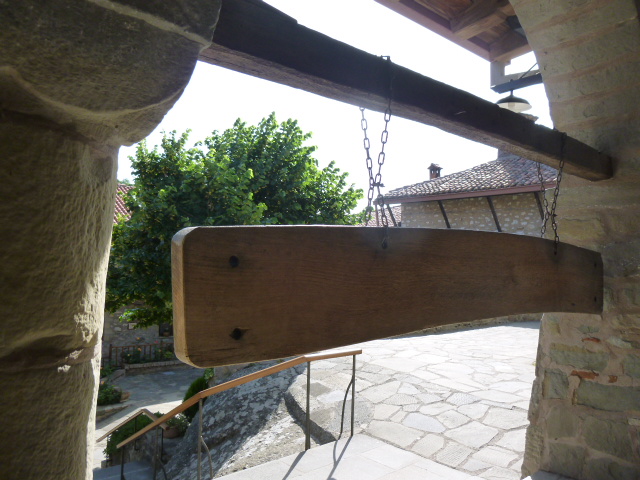
There are sheltered porches around the outside of the churches here - I have noticed this elsewhere - and these provide shade for standing for services on very hot days. We also note the simple sounding boards to call the faithful to prayers or to be used as a warning sign, from the Noah legend.

Varlaam with The Holy Monastery
of St Nicholas Anapausas in background
Photographs inside the buildings are largely forbidden - and this is good as it does help one focus on the spirituality of the places rather than always reaching for the camera - take away memories, not photos, is often a good maxim. But the icons, wall paintings, embroideries, wood carvings and other artifacts are wonderful. Jesus Christ as the good judge is invariably in the domes of the churches, with the four evangelists in supporting panels beneath and with other saints around the base. 

those steps up to Varlaam
Many coach tours are arriving together as we approach St Stephens and we get shuffled around in our groups and it is very hard to find and feel the spirituality of this place.
We re-board our coach and on the way to Varlaam stop for more views and photo shots of other monasteries and so to lunch.

The Palazzo restaurant we go to for lunch is well organised for dealing with several coach parties at a time - we are welcomed with a Greek aperitif served smilingly by waiters in Greek national dress - a nice touch in what could otherwise be a cavernous and impersonal place - self service with clearly labelled and priced food - and the trays carried to the tables for us - another welcome idea.


 So to Varlaam
and those 195 steps - Actually I only counted 115 to the top of the main flight - they then continue in easy low level steps to the top - these are wide and well constructed steps - and we had a cooling breeze - so it really is not as bad as it sounds - but perhaps avoid doing this in the midday heat.
I spy two lads right on the top of a rock - there is plenty of rock climbing around here unsurprisingly - they leave something behind - litter? Or camera? I hope neither! 
There are plenty more amazing photos here and here and plenty of greater detail about each of the monasteries to be readily found on line. With the hordes of tourists it can be quite difficult to find the spirit in these places but they are truly remarkable for all that.
panorama - spot the monasteries!


Wednesday, 4 November 2015

Travelling through Greece - Holy Monastery of St John the Forerunner


We are at the Holy Monastery of St John the Forerunner. Built on the site of sixteenth century ruins of an old church dedicated to St John the Baptist, the new church, a copy, is just 15 years old. The nuns have not been allowed to use old materials because of laws requiring churches to provide sanctuary and protection from earthquakes; thus the building has involved thick poured concrete with iron reinforcement and 2m foundations! We have been welcomed into the monastery grounds by Sister Theoktisti, very delightful, very English and she is proudly showing us their new church, not yet consecrated because it is not quite finished. The painting in the altar area is still to be completed.
Coming in from the brilliant sunshine our eyes take quite a while to acclimatise within the darkened church, as we stumble in the darkness to take up positions within, some sitting or perching on the narrow choir stalls (deliberately not, we are told, built for comfort, but more like the misericords in our cathedral and church choirs - for discretely perching in long services in days gone by!) There is a wonderful painting of the six days of creation above the six icons leading to the sanctuary. 
We are told that the monastery stands at 1100 metres and therefore gets very cold in the winter and is often snowed. It is not hard to imagine how beautiful it must then look, some compensation, I feel, for the inconveniences the snow must bring.   
Dazzled by the sun as we go outside once more, we make our way to a large covered area beyond the church where we are treated to welcome refreshments and have a chance to hear more about the monastery from Sister Theoktisti. People are returning to the country from the towns, she tells us, to find quality of life again and visitors come to worship at the church from as far as Larisa. There are 20 sisters in residence, and a further eight live just outside Athens. Some have even gone to Estonia to form a community there.
These nuns are closest to the Benedictines in life style, devoting their time to work, prayer and community life. They are pretty much self sufficient, only calling on local traders where necessary to supplement their own many and varied skills. For example they may need an electrician from time to time. They have livestock - pigs, goats chickens etc - and while not eating meat themselves they sell meat for funds - there is a waiting list for their beef because it is so good, being totally organic - and they have a very kind quiet slaughter producing the very best of meat in tenderness and flavour. They have also built up a successful market for their feta cheese. They don't have pets because that may cause contention as to "ownership" - whose "baby" is it?
The nuns grow all their own fruit and vegetables and do Christian art - such as icons, mosaics, carving, stitching etc according to individual skills, (the latest novice is learning homeopathy), much of this work being sold in their shop alongside jams, chutneys and honey etc.. Twenty women living together from 12 different cultures and with 22 languages between them bring their own challenges but it is clear that this also brings an incalculable richness into the community. The philosophy is not to worry about the way things happen. No one way is the only way - but to realise God's greatness and generosity in the diversity of culture. Different branches of Christianity, she reminds us, are almost an accident of birth - the ultimate choice being in our own hearts - we are all able to choose our own route to God if we leave our inherited path. And they never let the sun go down on their anger (See Paul's advice to the Ephesians 4: 26) After saying the final office of Compline every night they have a communal truth session - all asking for forgiveness of misdoings and offering total forgiveness in return. Not a bad plan for family life also I would say.

They are financially poor, but have a richness of life which money just cannot buy.
 
And so we make our farewells, climb the road back up to the coach which is waiting to take us down the Kesovos mountain and on our way to the main highway and our hotel for the night at Kalambaka below the dramatic Meteora Monasteries.
Passing through the village of Dimitra we see storks on their nests on the tops of posts and chimneys, even one atop a church, looking incongruously over crowded where parents were sharing the untidy pile of twigs with their two youngsters. The storks, while revered and regarded as lucky can be a nuisance and some people put dummy storks on their chimneys to keep the real ones away! Here we also see cotton everywhere - on the verges, in the fields, as we pass close to the birthplace of Asklepios and hear the myth of Chiron - and Asklepian healing - explored in my first book Healing this Wounded Earth, indeed the main inspiration for it.

Monastery of the Holy Trinity Meteora mountains
Eventually the Meteora mountains can be seen straight ahead in the distance - It is a place beyond words - but not mentioned by any ancient Greek authors, curiously perhaps. Much more about this amazing place in the next post...

Sunday, 1 November 2015

Travelling Through Greece - in the Steps of St Paul - via Mt Olympus

Ralph Waldo Emerson observed that "Life is a journey, not a destination."

So today's post is about journey - before arriving at our next destination The Holy Monastery of St John the Forerunner. 

As we drive between points on our pilgrimage I love to just observe through the coach window. There's always so much to see and the potential to miss too much.
The paddy fields continue to stretch away on either side of the road. These seem to be fed by irrigation channels - some like wooden troughs - connected with deeper ditches between the fields tracing back to the wide river which we drove over just before the road forks - the river which is feeding the Aliakmon-Axios Delta.
Mt Olympus and raptor
must get that shot of Mt Olympus!
Soon we take the left fork on the road towards Katerini and Athina and settle for a long drive, absorbing the landscape through which we pass: always the white and pink Oleander brightening up the sides of the main road and sometimes the dazzling yellow of broom - this used to be gathered in some parts of the country by the ladies of the house to make the brooms for sweeping their houses and yards (after the broom had flowered the women came up the mountains for a few days, leaving the menfolk behind, to cut and dry the choicest branches); many sad roadside shrines continue to mark fatalities from road crashes; and there are so many of the curious glistening silvery "nests" hanging in the pine trees - I often wondered what these were - more about these later - and the bare red earth of fire breaks can be seen snaking down the forested mountainsides in the distance.  
There is some roadside litter here but nowhere near the problem we have in the UK - there is lighter traffic here certainly - but perhaps there is less eating "on the hoof", the drivers more willing to relax at service areas for refreshment? It is surely our "grab to go" culture with convenience and plastic-wrapped food which, alongside a lack of awareness of its costs and dangers, makes England worse for litter than most of Europe, North America and Japan. I am appalled that even hotels feel the need to offer "grab and go" breakfasts for drivers who can no longer apparently find time for that most important of meals to start the day.
Mount Olympus can now be seen in the far distance and the Aegean sea is twinkling to our left - as we hear stories from our guide of the origins of Delphi - including how Kronus ate a stone instead of eating baby Zeus - how he later regurgitated it and how this very rock was and still is at the temple of Apollo at Delphi. There are some great legends centred around Delphi. 


On longer sections of our journey our local guide Mara and Mark Vernon both take the opportunity to fill us in on history and philosophy respectively and how these interface with our Christian pilgrimage. It has been said that: "Myths are the mirrors in which we can study human life." (the late and eminent psychotherapist Petrusca Clarkson). More than that, myths are a way of understanding the interface between the divine and the human - thus Plato's ideas of the good, the beautiful and the true - echoes of the doctrine of the Trinity in the ideas of Known, Knower and Knowing - Father, Son and Holy Spirit - show how our understanding of God is a mixture of the philosophical and the Biblical. 
There is a buzz around me in the coach as this is discussed - Mark is right - there is some philosopher in all of us.
 
There is snow on the top of Mt Olympus - its ancient myths contrasting sharply with the very modern solar panel farm to our right taking full advantage of the south facing and sunny slope. We hear about the stories behind the images on all the Greek coins, all different, and Mara says the Greeks find our pound sterling coins very unimaginative - with the head of the Queen on them all!
Olympus is now displaying the green skirts of its foothills and we begin to climb - past the strategically placed 10th century AD Platamonas castle on our left onto the highway connecting the North and South of Greece - a new road being built - and sometimes we criss-cross an even older track - much deteriorated now. Then we are diverted on to new stretches alongside the existing road - this will improve the journeys of the many lorries and coaches that use the route. This is the first really busy traffic we have met and we find ourselves in a long convoy - but the views from the new road will surely not be so spectacular. At the moment we are treated to stunning mountain scenery, some of the most dramatic in Greece, with wonderful views down into deep gorges, as we make progress up the Tempi valley towards Larisa.
There are many of the wayside shrines here - some very old and rusty, some newer and ceramic - and litter bins in the lay-bys are clearly used and emptied - 6th and 7th millennium BC Neolithic settlements have been found near here.
34 km short of Larisa we stop for a comfort break and drink - "coffee in-coffee out" as our guide puts it! It is 34 degrees outside but it is a dry heat and I am loving it - some however find it trying and make a dash for the air-conditioned café. 


Now we are on the high plain - a huge crop growing area, with golden fields of corn and stubble.We are beginning to see much more mechanisation and long spray bars are evident - whether for irrigation or chemicals I cannot tell. Hay is being tossed mechanically to dry in the sun, and gets baled into the old small rectangular style bales of my Kent childhood - now rarely seen in England, or indeed much of the rest of Europe, where hay is made into huge round plastic wrapped bales, moveable only by machine.


We climb even higher -  above the largest and most fertile plain in Greece - where cotton is the main crop. But farmers are apparently exhausting natural resources leading to water shortage and mineral depletion - by lack of rotation and diversification. Now some are trying a three year rotation between cotton, maize and potato - cotton is very heavy on mineral use - but the temptation is to lower quality of crop for quantity. We negotiate huge hairpins - giant mullein with massive yellow flower spikes, and wild fig trees and tall yellow thistles - cling to the side of the road above steep drops - this drive is not for the faint hearted. Groups of beehives tucked into woodland clearings are a promise of the wonderful honey soaked desserts to come which I cannot resist. 

The colourful hives attract bees and identify their owners - and the hives are moved according to the season, taking advantage of pine trees, thyme or the abundant wild flowers (the best quality). What a wonderful drive ever upwards above the snow line (marked by road signs warning of slippery ice) and towards the total isolation of Anatoli village and a few tortuous miles beyond that the very modern monastery of TheHoly Monastery of St John the Forerunner, our next destination.