My book Why Religions Work explores religious tolerance issues. It could not be more relevant at the moment with the world in its present state.
This blog has concentrated recently on the wonderful pilgrimages I have been on - to the Holy Land and to Turkey and more recently to Holy Georgia , Greece "In the Steps of St Paul" , Ethiopia and most recently my experiences in Iran.

"If I was allowed another life I would go to all the places of God's Earth. What better way to worship God than to look on all his works?" from The Chains of Heaven: an Ethiopian Romance Philip Marsden

Showing posts with label Meteora monasteries. Show all posts

Tuesday, 10 November 2015

Travelling Through Greece - Icons


We have feasted our eyes and spirits on the amazing views and monasteries of the Meteora mountains and now we head south in the coach to Trikala - the far mountains in their purple and blue haze contrasting with the orange roofs, green sweet corn crops and golden straw drying in the fierce sun in the nearer lowlands. 
Everywhere pylons and telegraph poles and wires criss-cross the landscape making photography difficult. We pass by big marble yards - there are several grains of marble to work with for different purposes - small grain are for delicate sculptures etc, large grains are for working tops and cemeteries - there is sadly a big market in the roadside shrines.
We are going to visit one of the most important iconographers in Greece - to an icon workshop - where the skill has been passed down through the generations and it is still very much family run. Now those who want to follow the art have to go to art school and obtain a licence to produce them. Traditionally the artist prayed as he painted - now those fresh from Icon art school are less likely to be so religious. In amongst the shops selling lighting and cars - a Mercedes Benz showroom, with servicing and elf petrol, a most unprepossessing entrance gives no clue to what we will find inside. 
We go through a nondescript entrance door to climb a cool wide marble staircase and so into the showroom where we are offered Greek Delight (like Turkish Delight but better, we are told!) - and plentiful freshly brewed coffee and water - all most welcome. It is very hot in the workshop where we are led - but the demonstration of how the icons are prepared ready for painting is fascinating.
Local wood is seasoned over 3 years - cedar, pine, walnut - olive (hardest of all) and beech. We saw how cotton is stretched on the frame with a glue mix to fasten layers - then to kiln - and finally smoothed with sandpaper for painting.
Then we go into the part of the shop where the icons are displayed, and there are three people sitting at easels painting them - and signing the backs of those we purchased - Who could not resist at least one - these seem very superior to those we have already purchased along the way. They are all truly beautiful - all shapes and sizes and saints - and we are allowed to take photos. I buy one as a present - on the basis of my father's maxim that the best presents are those you would like to receive yourself. 


What is an icon? Thomas Merton explains the icon as an act of witness: "What one sees in prayer before an icon is not an external representation of a historical person but an interior presence in light, which is the glory of the transfigured Christ, the experience of which is transmitted in faith from generation to generation..."

And different colours have different significance. Thus white represents eternal life and purity, blue is for celestial beings, God's dwelling place, the sky, red symbolizes activity, martyrdom, fire, the Last Judgment and so on...
This workshop is run by Father Bethkis (Greek for pine tree) and three generations of his family are working there - here is definitely worth a visit should you be anywhere nearby.

We are the first coach to arrive back at our hotel so those of us who feel the 195 steps to the Varlaam monastery were not exercise enough head straight for the pool - surprisingly few of us - the rest slink back to rooms for siestas. After my swim I head out along the main street to the centre of the town to explore. It's 4.30 and 34 degrees and there are few shops or coffee shops open yet. But I am after a coffee and cake and soon find myself seated without realising it at what is described on Tripadviser as the very best cafĂ© in town for coffee and cocktails. A cappuchino suits me well and it really is superb and served with such finesse by the lad who comes out to the pavement for my order. 
I write up my notes enjoying this and the cooling breeze which is just pleasant. It's a shame about the local youngsters whizzing around on smelly 2-stroke mopeds and the musak coming from somewhere to assault my senses. I look across to the central square which looks very sad and run down - with many closed shops and a dry fountain. Perhaps later in the season this will all come alive. I do hope so. There seems no shortage of coach parties who doubtless have money to spend here given the chance.
One thing still continually strikes me here - and I know I keep talking about this, but I feel very strongly about it. Yes there is litter, but nothing like that in the UK or Georgia. One has to ask why. Culture? Education? Less "fast food" and "food to go"? Provision of litter bins and labour to empty them? Perhaps a mix of all these things and more.

We again finish the day with Compline in a hotel room - before we are off to bed for an early start. We face a long drive to Athens tomorrow - but via Delphi which we are told is quite special.
                                                                                                        

We are being well looked after by our coach driver and his smart white coach with red livery from "Andy's Tours". Our tables in the restaurant here have been identified by cards saying "Andy's". Reference to the coach company or over familiarity with our Dean!?

Saturday, 7 November 2015

Travelling Through Greece In the Steps of St Paul - a diversion to the Meteora Monasteries


 Tuesday - It's our fourth full day on this wonderful pilgrimage and we are going to visit the quite extraordinary Meteora monasteries perched high on gigantic rocks in the central Thessalia Plain, Not anything to do with Paul's second journey but as one of the largest and most important Greek Orthodox monastery complexes after Mount Athos it is an essential destination in this part of Greece.
Holy Monastery of St Stephen - the only one occupied by nuns
sunbathing cat
There were five coach loads in our hotel when we arrived last night together with a seemingly large number of hunky hairy bikers on a German motor cycle rally judging by all the gleaming machines parked outside - but such is the scale of the hotel and their efficiency that we are not unduly disturbed by such large numbers; indeed we have the gorgeous swimming pool to ourselves on our second afternoon here, some time to relax and perhaps reflect on and assimilate all our experiences to date.
the talanton

First we are going to visit the Agios Stephanos, or St Stephen's Holy Monastery, the most accessible monastery of them all, approached simply by a small bridge from the road. Later we will climb the 195 steps to Varlaam - actually not so daunting as they sound - and by coach see the outside of the other four monasteries open to the public.
There are various theories as to how this amazing landscape formed. Mara tells us that 60 - 10 million years ago the river deposited material here. Then a huge earthquake opened up the area to the Aegean Sea, which swept in and eroded all the soft rocks, leaving just the massive stacks we see today.
The first inhabitants were hermits who lived in caves high up in the rock faces.
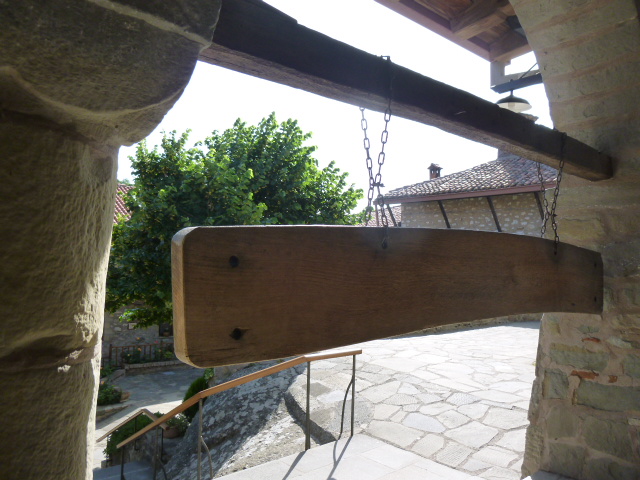
There are sheltered porches around the outside of the churches here - I have noticed this elsewhere - and these provide shade for standing for services on very hot days. We also note the simple sounding boards to call the faithful to prayers or to be used as a warning sign, from the Noah legend.

Varlaam with The Holy Monastery
of St Nicholas Anapausas in background
Photographs inside the buildings are largely forbidden - and this is good as it does help one focus on the spirituality of the places rather than always reaching for the camera - take away memories, not photos, is often a good maxim. But the icons, wall paintings, embroideries, wood carvings and other artifacts are wonderful. Jesus Christ as the good judge is invariably in the domes of the churches, with the four evangelists in supporting panels beneath and with other saints around the base. 

those steps up to Varlaam
Many coach tours are arriving together as we approach St Stephens and we get shuffled around in our groups and it is very hard to find and feel the spirituality of this place.
We re-board our coach and on the way to Varlaam stop for more views and photo shots of other monasteries and so to lunch.

The Palazzo restaurant we go to for lunch is well organised for dealing with several coach parties at a time - we are welcomed with a Greek aperitif served smilingly by waiters in Greek national dress - a nice touch in what could otherwise be a cavernous and impersonal place - self service with clearly labelled and priced food - and the trays carried to the tables for us - another welcome idea.


 So to Varlaam
and those 195 steps - Actually I only counted 115 to the top of the main flight - they then continue in easy low level steps to the top - these are wide and well constructed steps - and we had a cooling breeze - so it really is not as bad as it sounds - but perhaps avoid doing this in the midday heat.
I spy two lads right on the top of a rock - there is plenty of rock climbing around here unsurprisingly - they leave something behind - litter? Or camera? I hope neither! 
There are plenty more amazing photos here and here and plenty of greater detail about each of the monasteries to be readily found on line. With the hordes of tourists it can be quite difficult to find the spirit in these places but they are truly remarkable for all that.
panorama - spot the monasteries!


Wednesday, 4 November 2015

Travelling through Greece - Holy Monastery of St John the Forerunner


We are at the Holy Monastery of St John the Forerunner. Built on the site of sixteenth century ruins of an old church dedicated to St John the Baptist, the new church, a copy, is just 15 years old. The nuns have not been allowed to use old materials because of laws requiring churches to provide sanctuary and protection from earthquakes; thus the building has involved thick poured concrete with iron reinforcement and 2m foundations! We have been welcomed into the monastery grounds by Sister Theoktisti, very delightful, very English and she is proudly showing us their new church, not yet consecrated because it is not quite finished. The painting in the altar area is still to be completed.
Coming in from the brilliant sunshine our eyes take quite a while to acclimatise within the darkened church, as we stumble in the darkness to take up positions within, some sitting or perching on the narrow choir stalls (deliberately not, we are told, built for comfort, but more like the misericords in our cathedral and church choirs - for discretely perching in long services in days gone by!) There is a wonderful painting of the six days of creation above the six icons leading to the sanctuary. 
We are told that the monastery stands at 1100 metres and therefore gets very cold in the winter and is often snowed. It is not hard to imagine how beautiful it must then look, some compensation, I feel, for the inconveniences the snow must bring.   
Dazzled by the sun as we go outside once more, we make our way to a large covered area beyond the church where we are treated to welcome refreshments and have a chance to hear more about the monastery from Sister Theoktisti. People are returning to the country from the towns, she tells us, to find quality of life again and visitors come to worship at the church from as far as Larisa. There are 20 sisters in residence, and a further eight live just outside Athens. Some have even gone to Estonia to form a community there.
These nuns are closest to the Benedictines in life style, devoting their time to work, prayer and community life. They are pretty much self sufficient, only calling on local traders where necessary to supplement their own many and varied skills. For example they may need an electrician from time to time. They have livestock - pigs, goats chickens etc - and while not eating meat themselves they sell meat for funds - there is a waiting list for their beef because it is so good, being totally organic - and they have a very kind quiet slaughter producing the very best of meat in tenderness and flavour. They have also built up a successful market for their feta cheese. They don't have pets because that may cause contention as to "ownership" - whose "baby" is it?
The nuns grow all their own fruit and vegetables and do Christian art - such as icons, mosaics, carving, stitching etc according to individual skills, (the latest novice is learning homeopathy), much of this work being sold in their shop alongside jams, chutneys and honey etc.. Twenty women living together from 12 different cultures and with 22 languages between them bring their own challenges but it is clear that this also brings an incalculable richness into the community. The philosophy is not to worry about the way things happen. No one way is the only way - but to realise God's greatness and generosity in the diversity of culture. Different branches of Christianity, she reminds us, are almost an accident of birth - the ultimate choice being in our own hearts - we are all able to choose our own route to God if we leave our inherited path. And they never let the sun go down on their anger (See Paul's advice to the Ephesians 4: 26) After saying the final office of Compline every night they have a communal truth session - all asking for forgiveness of misdoings and offering total forgiveness in return. Not a bad plan for family life also I would say.

They are financially poor, but have a richness of life which money just cannot buy.
 
And so we make our farewells, climb the road back up to the coach which is waiting to take us down the Kesovos mountain and on our way to the main highway and our hotel for the night at Kalambaka below the dramatic Meteora Monasteries.
Passing through the village of Dimitra we see storks on their nests on the tops of posts and chimneys, even one atop a church, looking incongruously over crowded where parents were sharing the untidy pile of twigs with their two youngsters. The storks, while revered and regarded as lucky can be a nuisance and some people put dummy storks on their chimneys to keep the real ones away! Here we also see cotton everywhere - on the verges, in the fields, as we pass close to the birthplace of Asklepios and hear the myth of Chiron - and Asklepian healing - explored in my first book Healing this Wounded Earth, indeed the main inspiration for it.

Monastery of the Holy Trinity Meteora mountains
Eventually the Meteora mountains can be seen straight ahead in the distance - It is a place beyond words - but not mentioned by any ancient Greek authors, curiously perhaps. Much more about this amazing place in the next post...