My book Why Religions Work explores religious tolerance issues. It could not be more relevant at the moment with the world in its present state.
This blog has concentrated recently on the wonderful pilgrimages I have been on - to the Holy Land and to Turkey and more recently to Holy Georgia , Greece "In the Steps of St Paul" , Ethiopia and most recently my experiences in Iran.

"If I was allowed another life I would go to all the places of God's Earth. What better way to worship God than to look on all his works?" from The Chains of Heaven: an Ethiopian Romance Philip Marsden

Showing posts with label mor gabriel. Show all posts

Monday, 25 November 2013

Mardin and the Saffron Monastery - our pilgrimage continues...


at the Saffron Monastery
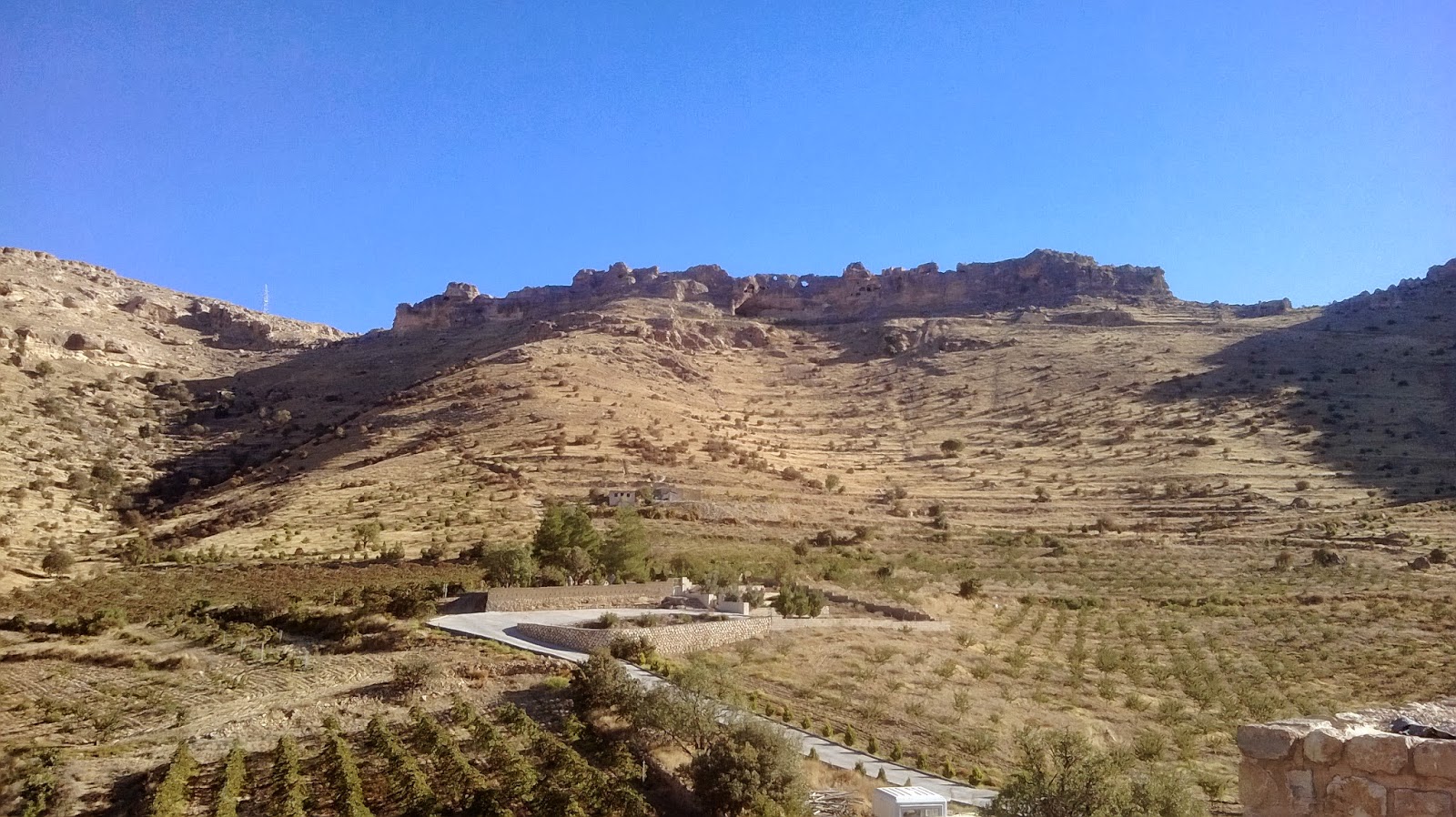
Unofficially closed to tourism throughout the 1990s due to the long lasting Turkey-PKK conflict in the surrounding countryside (and that possibly explains why it is omitted from most of the guidebooks to the area), Mardin has recently started to catch up with tourism (still don't expect hordes of package tourists though) and will reward the adventurous traveler with some colorful culture, plenty of historical interest, beautiful architecture and some fabulous vistas. Mardin is one of the oldest settled areas in upper Mesopotamia, lying at the heart of the homeland of the Syriacs, whose ancestors established here around 2200 BC. The Syriac language is directly related to Aramaic, the language spoken by Jesus Christ. The many madrasas and mosques in the city owe their presence to the fact that Mardin was the capital of the Turkic Artukid dynasty between the 12th and 15th centuries.
the self supporting roof at the Saffron Monastery
in the courtyard at the monastery
Approaching by coach from the south the old houses seem to tumble down the hillside in glorious disarray, topped by the citadel at the very top, and all in the attractive beige colored limestone rock of the region. We had passed several of these quarries on our travels. For those who love trivia, Mardin is apparently twinned with Llubljana in Slovenia. But much more important is its historical significance. With remains dating back to 4000 BC the town has in its time been controlled by many different tribes, from the Subarians, to the Hurrians, the Elamites, Babylonians, Hittites, Assyrians, Romans and Byzantines, to name a few. The town has been fought over many times in its turbulent history.

After we have been welcomed to the Saffron Monastery, finished our glasses of refreshing cay and found our rooms, (not so good, it has to be said, as those at Mor Gabriel) we have a tour of the monastery before evening prayer.
the sutoro across the front of the sanctuary
This monastery is well and truly on the tourist route, a well known attraction, with more than 10,000 visitors a year from within Turkey and from abroad, 70% of whom are Muslim. Living in the monastery with Bishop Philoxenus are a nun, a monk and a few boys, and they can take 20 guests, but whilst the liturgy of morning and evening prayer is maintained, it is not a fully functioning monastery as at Mor Gabriel and Mor Augin.

First we go to a very old room with a self supporting roof – there is absolutely no mortar, the roof held up simply by the pressure of the huge rocks against themselves. The room dates back at least to Roman times, but we cannot be sure what it may have been. Some date it back 4500 years to a pagan temple site, a Zoroastrian temple possibly? But there is no definitive evidence of this.
at the Saffron Monastery

Morning prayer starts not quite so early at the Saffron Monastery. Here the females among us sit as we sat in Mor Gabriel, on the right hand side of the church, our heads covered in headscarves or shawls as required in orthodox churches. The men enter a few minutes later. It seems they are not so good at getting up early?! Following our lead, they take their places on the simple benches to the left. We think it slightly strange that in one part of the liturgy the monk comes and sits with us, looking slightly awkward. We discover the next morning that we should be sitting on the left, leaving the right side for the men. Oh dear! Faux pas! But who is correct? Mor Gabriel or the Saffron Monastery? There seems to be some confusion over the protocol.

sunset at the Saffron Monastery
Time for breakfast; it is Friday so no meat or eggs. I miss the hard boiled egg. But the fig preserve to spread on the fresh bread is simply superb, even if I still find it difficult to eat piles of olives with slices of cucumber for breakfast. And there is plentiful cay on offer. In the same way that many westerners seem to find it impossible to start the day without a shot of caffeine, a need that only strong black coffee can satisfy, I find it hard to function without copious cups of tea first thing. I have come to love the cay, even without milk. 

Evening meals for my veggie taste prove difficult here in the Saffron Monastery. We walk in to take our places each evening to plates already set in front of us with the evening fare. It is always meat, (except Friday) with a side salad. So I have to satisfy myself with the latter with plenty of bread, making up for my hunger at our lunchtime stops where I have enjoyed the many different variants of menemen, supplemented with the fantastic array of salad side dishes available.

a sutoro (painted cloth hanging)

So into the coach for our last full day of pilgrimage, and in to Mardin where we will explore just a few of its many churches and enjoy its shops, cafes and local culture, time even for some souvenir shopping before we finally head for home tomorrow...


a view from the roof of the Saffron Monastery

Monday, 18 November 2013

The Road to Mor Yacoub and Yoldath Aloho, in Tur Abdin

Mor Gabriel at break of day
Today we have a treat to start the day at Mor Gabriel. After the usual morning liturgy we celebrate our Anglican Eucharist in the church before heading for breakfast. That is such a great experience - and a privilege for our priests to be allowed to use the sanctuary, with incense as well!
I have to confess that I am finding it hard to get into the liturgy of Mor Gabriel. I discuss this with our bishop, and realize that I need to feel the mystery of the Eastern Orthodox tradition. East and West need to meet on this, the western tradition being rather more ritualistic, lacking in some of this mystery that is second nature here. It is hard for me to find that here just yet. There have been so many experiences to assimilate. Perhaps I just need a little more time and space. This is almost certainly why I enjoy the use of incense in church back home, although it is not generally popular with our congregation – that’s such a shame!
the church sanctuary at Mor Yacoub

With ablutions and breakfast over, we are ready to go, and are joined for the day by one of the teaching monks (malfonos) from the monastery and his brother from the village. So we set off on the road again, this time to visit the early sixth century monastery of Mor Yacoub (Yakub), at Saleh. Fr Daniel here was kidnapped for two days a couple of years ago but was released unharmed. He is not here when we arrive; he is probably out on the fields farming and will not hear his phone, we are told. We explore the site, making our way first to the church. It is very wide, with a transverse nave, which allows maximum room for the congregation to prostrate themselves in prayer. The church was built in 512. Its roof is very similar to that seen in the church at Mor Gabriel, except that here the stone arches in the roof are painted to look like bricks! This was all in ruins not so long ago and has been rebuilt. Five years ago the rubble of the ruins was still being cleared out – so we see that astonishing progress has been made; yet another example of the incredible resilience of the Christian communities in this part of Turkey. But there has been a problem with the renovations; the acids in the concrete used on the roof have damaged the original roof coloring.
We saw two churches at this monastery, the second older than the first. In the grounds we also saw the ruins of what may originally have been an old pagan temple, although this is not certain.
Mor Yacoub
So we retrace our steps and turn back onto the road towards Dargecit. This is a new road, being redone. We pass a village on the left as we turn off to the right onto a very poor dust road. As we drive up to Anitli or Hah, a remote village seemingly in the middle of nowhere, we are met by excited children waving to us. I wonder how often they see large coaches coming through their narrow roads? Not that often I think. It is here that Gertrude Bell was robbed some 102 years ago while visiting the area. The soil here is very rich but stony. Bulldozers have transformed the agriculture here by cleaning up the fields and enabling walls to be built with the stones. Grapes, pistachio, olives, figs, several types of berry and fabulous pomegranates are all being grown. The farmers also grow and harvest acorns for animal feed. This explains what I had thought were fields of miniature oak trees seen from the coach. Perhaps they really were! I discover later that many animals feed on unripe acorns on the tree or ripe ones that fall on the ground. These animals include pigs, squirrels, bears, and deer as well as birds such as pigeons, jays and ducks. They are rich in carbohydrates and proteins as well as many minerals and vitamins, although the tannin in them can be toxic. I’m sure the locals will know this.
But litter is still a problem, as I have mentioned elsewhere... it is such a shame to see countryside polluted and despoiled in this way.
possible pagan ruins at Mor Yacoub?
Dating back to the 6th century, the beautiful Yoldath Aloho (Mother of God) Church or Church of the Virgin Mary in Hah (now Anitli) was until 613 AD the seat of the region’s first bishop, and was again so between the 11th and 13th centuries. There is a bell tower and a striking two story square structure above the church, both of which were built in the 20th century. The church sits within a courtyard, known as abeth slutho, or house of prayer. I believe that this is used in the excessive summer heat when the inside of the church is too uncomfortable to use for prayer. The church has the transverse nave structure as seen at Mor Yacoub earlier in the day.
the beautiful Yoldath Aloho at Hah
I wonder why the bishopric was once located in such a remote place, why this is such an important church. In an extension of the Christmas story as recorded in the Holy Bible, of the Three Kings who followed the star to Bethlehem to find the infant Christ, legend says that there were actually twelve Kings. At Hah, only three out of the group proceeded to Bethlehem, and on finding the baby and handing over their gifts of gold, frankincense and myrrh, they were given a band from the swaddling clothes in which Jesus was wrapped. Bringing this back to Hah, they burnt it so that the ash could be divided between the twelve kings, but there were no ashes, only twelve gold medallions remained. The Kings put these into the foundations of the church built to commemorate this miracle. The church within the monastery has conserved some of its original details, which are thought to date back to the 3rd century AD. This makes it one of the oldest churches in the world, and perhaps the oldest of all if the Syriac legend surrounding its original founding is true.
Ancient lectionaries in the courtyard? 
The Mother of God church is a very beautiful church and I wanted to linger here, soaking up the spiritual atmosphere. We were once again treated to our Deacon singing the Lord’s Prayer in Syriac, (a dialect of Aramaic, which is a group of many related languages: the diversification is complex due to its long history, its extensive literature and its development in different religions through that time – much more detail can be accessed on the internet).
But we have to move on. So we climb up to the terrace above the church where under the shelter of a very modern gazebo to protect us from the harsh midday sun, we are treated to the traditional cay before being led to lunch in a room below, hosted by the mukhtar or mayor of Salah, Habib Doghan.
The lunch was superb, but we must soon be on the move again. There are other remains of churches and monasteries to see around the village and the mayor comes with us to proudly show them to us:

ruins of Mor Sobo
First there are the ruins of Mor Sobo Basilica. We are told these date back to the sixth century, but some sources date them as from a century or two later than that. These have been the subject of excavations by archaeologists from Mardin over the last 3 years. Part of a cross on one of the walls is pointed out to us. This was once one of the largest churches in Tur Abdin and used to house an ancient illuminated gospel manuscript, pained in 1227, which is now kept at Mor Gabriel. It seems that the church may at one time have been used as a mosque, the square bell tower as the minaret.
Then we walk through dusty pathways through the village, flanked on each side by stone walls topped often with prickly branches; I suspect these are constructed to keep livestock in their enclosures. Similar branches also seem to be stored and used as fuel. Here we find the little church of Mor Shmuel and the ruins of a former monastery dedicated to Sts Sergius & Bacchus (789 AD).

at the monastery dedicated to Sts Sergius and Bacchus
a path in Anitli


We were given a grand farewell by the mayor and some villagers who showered us with pomegranates and grapes before we climbed into the coach and set off again. Back onto the main Dargecit road we made our way towards Midyat; to see more churches and more of the important Syriac architecture of the region...the day still had plenty to offer ...to be contd...

Sunday, 17 November 2013

Mor Gabriel monastery: experiencing the Syriac Christian Orthodox liturgy

We are woken up by the loud bell in the bell tower near our room. It’s only 5.30 in the morning and it’s very cold! We grab some warm clothes, tie our scarves over our heads and make our way across the quadrangle to the church for the first liturgy of the day. As women tradition says we should sit on the left hand side and the men sit on the right. The nuns come to join us, sitting behind us at the back of the church. The church is gloomy, the atmosphere subdued. I think we’re not quite awake yet! Boys start to appear and gather around the two lecterns at the front of the church to each side, north and south, left and right. Soon they begin to chant or intone – antiphonally – first from one side, then the other. They stand with arms folded, all around the lecterns, so that some are reading the book on the lectern from the side or upside down! The shorter boys stand closer to the lectern. The liturgy is in classical Syriac - so we have no idea what is being said. More boys drift in, and the monks, over the next ten minutes or so – and they take their places at the lecterns - the time keeping seems quite relaxed, no one seems bothered if you are “late”. Every so often the boys and monks step over to carpets on the floor, where they kneel facing the sanctuary and prostrate themselves, all together, as they chant prayers, reminding us that the prostration for prayers which we think of as a Muslim way of prayer in fact originated before Islam in the Orthodox Christian worship.

Then the thurifer appears, the boy carrying the thurible or incense burner. He is dressed in a white alb, with crossed sashes perhaps denoting his seniority? He stands in front of us and swings the thurible in four directions, north, south, east and west, rotating on the spot as he does so. Then he goes around the church, censing the font and the several colorful hangings around the walls, called Sutore (sutoro singular). These hang on the bare walls and there is also a large one hanging from a curtain pole separating the sanctuary from the congregation. This is pulled open at various stages in the liturgy to reveal the sanctuary. On the altar a paten and chalice are in a state of readiness to celebrate the eucharist at any time. The liturgy proceeds like this for the best part of an hour. We get into the rhythm, standing whenever the incense is being used, and whenever the prostrations tell us that prayers are being said. Otherwise we sit.

the sanctuary sutoro
The atmosphere becomes increasingly charged with the incense, giving a sense of mystery and wonder to the proceedings. Finally the monk in charge, or on this occasion at Mor Gabriel the Archbishop, resplendent in his bright crimson habit, takes his position in front of the sanctuary. We queue to walk to the front of the sanctuary to where the Bible is placed – kiss it, and make our way back, touching the hand of the monk to receive a blessing from him. There is an order of hierarchy to this – men first, in order of seniority, followed by the boys, then the women, ordained first… where does a female priest place herself here? Does she join her male priest colleagues? The monks think not! Do we respect their attitude towards women? Or assert our priestly position, female or not? This is tricky and views inevitably vary!
There is just about enough time for a shower before breakfast. The total service has taken a little over an hour.


The process is repeated when we return to the monastery after our day out, when we join the boys and monks for Ramsho, the evening liturgy. After that liturgy we walk out into the evening sunshine, in time to see one of the boys drawing water up from the well just outside the church.
Time soon for supper and bed. After such an early start to each day no one seems to object to going to bed early, at 8 or 9 pm at the latest. That suits me just fine!


For further detail there is an excellent paper Monasticism in Tur Abdin: A Present Day Account by Mark DelCogliano in Cistercian Studies Quarterly 41.3 2006 p. 311

Friday, 15 November 2013

Mor Gabriel Monastery, Tur Abdin

In the late 1990s the road up to the Mor Gabriel monastery had to be closed at dusk because of the civil war in the region. The local kurds would shoot anyone driving up after dark.
As we make our way there in the coach now we are reminded that we are in a feudal area, ruled by overlords, Agha or Kurdish chieftains. In the worst of the troubles, the safety of the monastery and Christians in the area was threatened and 90% of the Christians emigrated, many to Sweden or Germany. The 20,000 Christian population dropped to nearer 2000. We also learn that there has been a bad relationship between the villagers and the monastery over land ownership.
Recently though the Agha system has been collapsing and there has been a massive improvement over the last 2-3 years in the local situation. Just from our coach we can see a building boom all around, the checkpoints have gone, where they used to be every 4-5 km, and villagers are coming back to their villages. There may now be five to ten Christian families again in each village. The plain is so fertile for arable crops that the farmers can work very hard for a few months of the year and then afford to go away for long holidays somewhere warm during Turkey’s harsh winter.

the entrance to Mor Gabriel
We are to stay here for two nights. Mor Gabriel, (otherwise known as Dayro d-Mor Gabriel or Deyrulumur and the seat of the bishopric of Tur Abdin) is the greatest of the Tur Abdin monasteries. This monastery has strong links with the Church of England through the Tur Abdin Focus Group. We are formally greeted by Mor Timotheus Samuel, who has been the Archbishop of Tur Abdin since 1985. For our leader Stephen Griffiths this is like a homecoming; he clearly feels very comfortable and at ease here. He has spent many years studying this part of Turkey and its Syriac Orthodox religion, getting to know the people well. Immediately on arrival we are invited to sit in a huge circle on the balcony in the shade. We are served the usual small glasses of cay by boys, students and lay workers at the convent, and we sit around talking for quite some time. We are not used to this style of welcoming and hospitality in our hurried western world, but here we are to become very used to it over the next few days. On this first day we seem reticent to speak and somewhat daunted by what seems a strained atmosphere.
The Archbishop is chatting with the Revd Stephen Griffiths, Abba Seraphim, (Primate of The British Orthodox Church within the Coptic Orthodox Patriarchate), Archimandrite Deiniol (of the Wales Orthodox Mission of the Ukrainian Orthodox Church) and Bishop Christopher of the Anglican Diocese of Southwark, updating on the local situation particularly about the land dispute with the Turkish government that threatened the monastery's very existence and which is very much on everyone’s mind at present.
Then our accommodation is sorted out. There is a new wing and an old wing. I’m in one of the old rooms, which seems good enough, although with 4 single beds very close together albeit with our own modern bathroom this would have been quite uncomfortable with 4 females. Fortunately there are only two of us!
guidance for visitors
There is very little parking space for cases, clothes, and the general clobber of 2 women, let alone 4!! But it was fine. The new accommodation is apparently very much nicer with tables to write at, much more space and lovely views to the south over the Tur Abdin region.
But when one reflects on the plight of so many refugees not so very far from here in refugee camps how can we complain? 
Once the greeting and accommodation is all sorted out we have a tour of the monastery. Established in 397, this is the oldest Syriac Orthodox monastery in the world, and the most vital, with some 15 nuns, two monks, several lay workers and always providing hospitality to visitors from overseas. It is very much a working community, with productive gardens and orchards, and
its primary purpose “is to keep Syriac Orthodox Christianity alive in the land of its birth by providing schooling, and ordination of native-born monks." 
On occasions it has provided physical protection to the Christian population during the civil strifes.

This is such a fascinating area of Turkey, and the tenacity and perseverance shown by monasteries such as Mor Gabriel through the difficult times they have suffered is surely an inspiration to us all...

For those interested in looking at the situation of the Christians in Tur Abdin in more detail, I can recommend the following links:
For a very succinct explanation of the political situation as it has affected Syrian Christianity in the Tur Abdin region of South East Turkey there are the reports from 1997 onwards from the Revd. Stephen Griffiths on the Tur Abdin Focus Group website – for example see  http://www.focusmorgabriel.com/articles/article0002.php for his first visit in 1997, with much detail of the history of the Syriac Christian Church up to that time: http://www.focusmorgabriel.com/articles/article0012.php for more on the political background. Also http://www.focusmorgabriel.com/articles/article0011.php Will the Christians be driven out? for even greater detail and analysis…
Also http://theorthodoxchurch.info/blog/news/2013/10/turkey-religious-freedom-and-the-current-state-of-christian-muslim-dialogue/ for more background to the current status of the church in Turkey
and for the land dispute see http://www.zenit.org/en/articles/gem-of-christian-history-at-risk-in-turkey for the detail on the land dispute and the latest somewhat more positive update at http://theorthodoxchurch.info/blog/news/2013/10/return-of-mor-gabriel-monastery-land-approved/

the deer that lives at the monastery cared for by one of the nuns