My book Why Religions Work explores religious tolerance issues. It could not be more relevant at the moment with the world in its present state.
This blog has concentrated recently on the wonderful pilgrimages I have been on - to the Holy Land and to Turkey and more recently to Holy Georgia , Greece "In the Steps of St Paul" , Ethiopia and most recently my experiences in Iran.

"If I was allowed another life I would go to all the places of God's Earth. What better way to worship God than to look on all his works?" from The Chains of Heaven: an Ethiopian Romance Philip Marsden

Showing posts with label menemen. Show all posts

Monday, 25 November 2013

Mardin and the Saffron Monastery - our pilgrimage continues...


at the Saffron Monastery
Unofficially closed to tourism throughout the 1990s due to the long lasting Turkey-PKK conflict in the surrounding countryside (and that possibly explains why it is omitted from most of the guidebooks to the area), Mardin has recently started to catch up with tourism (still don't expect hordes of package tourists though) and will reward the adventurous traveler with some colorful culture, plenty of historical interest, beautiful architecture and some fabulous vistas. Mardin is one of the oldest settled areas in upper Mesopotamia, lying at the heart of the homeland of the Syriacs, whose ancestors established here around 2200 BC. The Syriac language is directly related to Aramaic, the language spoken by Jesus Christ. The many madrasas and mosques in the city owe their presence to the fact that Mardin was the capital of the Turkic Artukid dynasty between the 12th and 15th centuries.
the self supporting roof at the Saffron Monastery
in the courtyard at the monastery
Approaching by coach from the south the old houses seem to tumble down the hillside in glorious disarray, topped by the citadel at the very top, and all in the attractive beige colored limestone rock of the region. We had passed several of these quarries on our travels. For those who love trivia, Mardin is apparently twinned with Llubljana in Slovenia. But much more important is its historical significance. With remains dating back to 4000 BC the town has in its time been controlled by many different tribes, from the Subarians, to the Hurrians, the Elamites, Babylonians, Hittites, Assyrians, Romans and Byzantines, to name a few. The town has been fought over many times in its turbulent history.

After we have been welcomed to the Saffron Monastery, finished our glasses of refreshing cay and found our rooms, (not so good, it has to be said, as those at Mor Gabriel) we have a tour of the monastery before evening prayer.
the sutoro across the front of the sanctuary
This monastery is well and truly on the tourist route, a well known attraction, with more than 10,000 visitors a year from within Turkey and from abroad, 70% of whom are Muslim. Living in the monastery with Bishop Philoxenus are a nun, a monk and a few boys, and they can take 20 guests, but whilst the liturgy of morning and evening prayer is maintained, it is not a fully functioning monastery as at Mor Gabriel and Mor Augin.

First we go to a very old room with a self supporting roof – there is absolutely no mortar, the roof held up simply by the pressure of the huge rocks against themselves. The room dates back at least to Roman times, but we cannot be sure what it may have been. Some date it back 4500 years to a pagan temple site, a Zoroastrian temple possibly? But there is no definitive evidence of this.
at the Saffron Monastery

Morning prayer starts not quite so early at the Saffron Monastery. Here the females among us sit as we sat in Mor Gabriel, on the right hand side of the church, our heads covered in headscarves or shawls as required in orthodox churches. The men enter a few minutes later. It seems they are not so good at getting up early?! Following our lead, they take their places on the simple benches to the left. We think it slightly strange that in one part of the liturgy the monk comes and sits with us, looking slightly awkward. We discover the next morning that we should be sitting on the left, leaving the right side for the men. Oh dear! Faux pas! But who is correct? Mor Gabriel or the Saffron Monastery? There seems to be some confusion over the protocol.

sunset at the Saffron Monastery
Time for breakfast; it is Friday so no meat or eggs. I miss the hard boiled egg. But the fig preserve to spread on the fresh bread is simply superb, even if I still find it difficult to eat piles of olives with slices of cucumber for breakfast. And there is plentiful cay on offer. In the same way that many westerners seem to find it impossible to start the day without a shot of caffeine, a need that only strong black coffee can satisfy, I find it hard to function without copious cups of tea first thing. I have come to love the cay, even without milk. 

Evening meals for my veggie taste prove difficult here in the Saffron Monastery. We walk in to take our places each evening to plates already set in front of us with the evening fare. It is always meat, (except Friday) with a side salad. So I have to satisfy myself with the latter with plenty of bread, making up for my hunger at our lunchtime stops where I have enjoyed the many different variants of menemen, supplemented with the fantastic array of salad side dishes available.

a sutoro (painted cloth hanging)

So into the coach for our last full day of pilgrimage, and in to Mardin where we will explore just a few of its many churches and enjoy its shops, cafes and local culture, time even for some souvenir shopping before we finally head for home tomorrow...


a view from the roof of the Saffron Monastery

Saturday, 23 November 2013

Our Pilgrimage to South East Turkey: Nusaybin and Mor Yakup

street cleaning in Nusaybin
Those who know me well will realize how much I campaign against litter! The very first thing that struck me about the town of Nusaybin was how clean it was. Here I had my first sight on this trip to Turkey of a street cleaner complete with wheelbarrow, brush and shovel, and he was doing a very good job. For the first time everywhere looked so well maintained and cared for, including some public gardens that looked very neat and tidy. . I wonder what makes the difference? Why does this town care so much more than others we have been through?

The border post here with Syria is now closed and has been for quite some time because of the civil war in Syria. There is a Byzantine ruin near the border which we cannot visit. 

Instead we are here to see the recently excavated 4th century church of St Jacob - Mar Yakub - which is now re-established. A number of ancient buildings have been revealed by the excavations, in addition to the Mar Yakub church, which was the center of the famous Syrian Theological School, founded by St James of Nisibis in 350. His sarcophagus is still in the crypt. We are told that the town mayor has encouraged the excavations, which he hopes to use as an educational opportunity; to show people the variety of religions and cultures of the area over time. The more we can educate everyone, from all cultures and faiths, about our differences and indeed our common ground, the more hope there is for interfaith harmony and understanding.

But first we have lunch. It’s an excellent local restaurant – really busy at lunchtime with locals, which is always a good sign. My salad is superb, with pomegranate juice and dressing, and again the wonderful fresh flat bread which always seems to be readily available at meal times. And they made a menemen again for me – this time it’s spread thinly over a large concave metal skillet, and is simply delicious. In this warmer southern part of Turkey we have been drinking plenty of ayran – a salted yoghourt drink – I love it and it’s wonderful when the weather is hot. And I love it when they serve it in cool pewter mugs!

The Mar Jakub site is quite extraordinary. There is still plenty of excavation going on and we are not allowed to take photos of the work in progress – within the church itself we have a guide, and our own tour guide Gilgud translates for us. Through her he tells us that his is the only Christian Syriac family in the town. And he gives us a brochure on The Nusaybin school and Mor Yakop Church. It's a very informative booklet and I hope to be able write a little more about this impressive project at a later date.

Mar Yakub church
On the excavation site we had spoken to an extremely well dressed and well spoken lady who was there with her daughter. She explained in perfect English that she was a Kurdish Syrian from Damascus and that her daughter could not go to school here as this was not allowed by the Turkish government. I'm not sure that the daughter was as concerned as her mother! We wished them our blessings and hope for peace and a better future, said how sorry we were for the situation they found themselves in, promised to pray for them both and waved goodbye. As we walked away from the site a refugee family on the roof of the building above us waved.

inside Mar Yakub church
So we set off again, westwards towards Mardin, and our accommodation for the last two nights of our tour - this time at Mor Hananyo monastery, otherwise known as Deir Zafaran, Deyrelzafaran or the Saffron Monastery. The monastery was once the seat of the Syriac Orthodox Patriarchs of Antioch from 1293-1932 when the patriarchate was moved to Syria because of limitations imposed by the Republic of Turkey on religious activities. I am led to understand that the Turkish government would like the Patriarch to leave Damascus and relocate back in Turkey. Is that right?


view from the Saffron Monastery
Anyway, the monastery really is quite simply magnificent, 
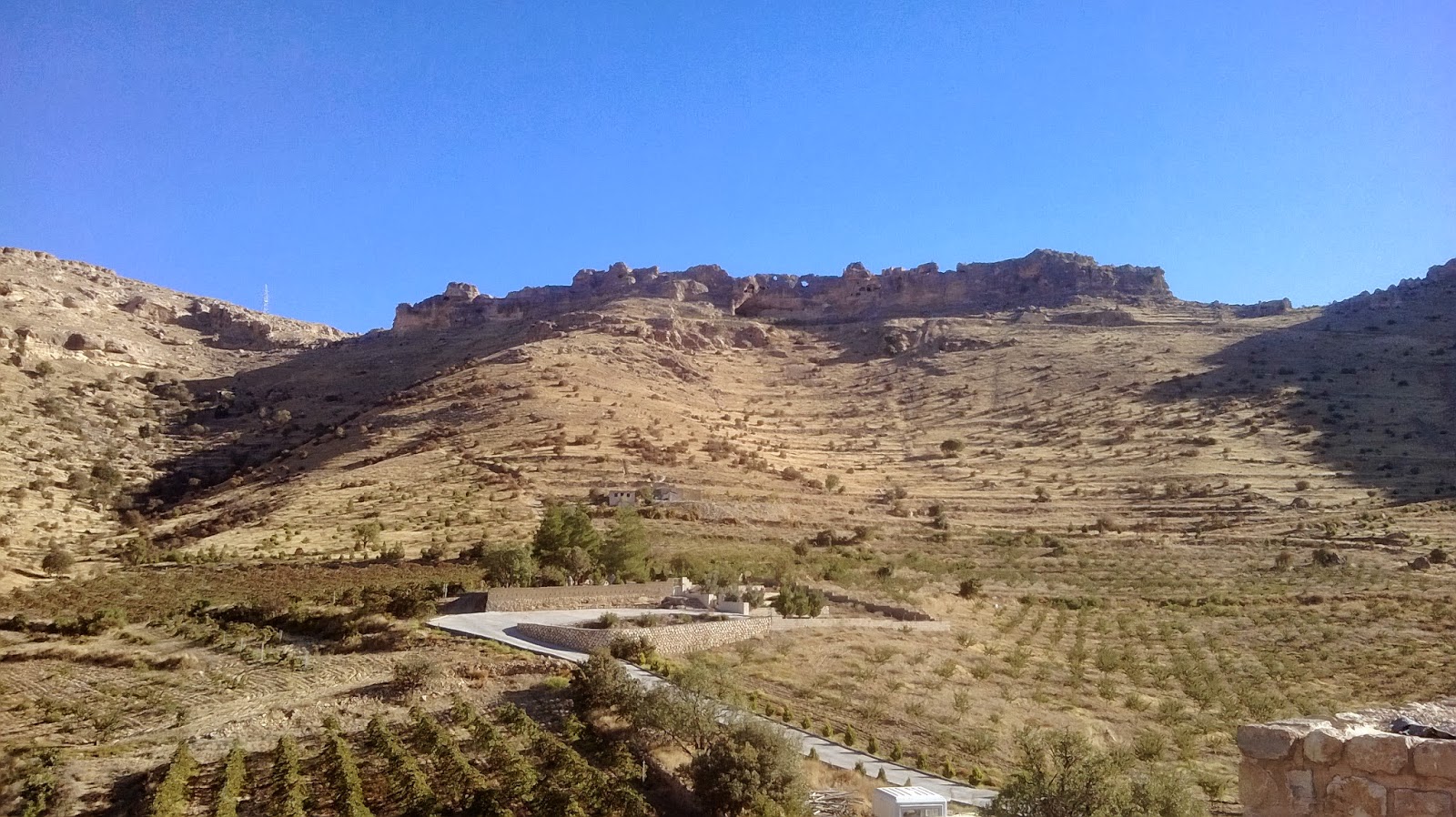
nestling as it does under the cliffs amid lovely gardens looking down across the great plain of Mesopotamia towards the Syrian border, some 5km east of Mardin. The beautiful honey-colored stone glows in the special light in this part of Turkey, particularly at sunrise and sunset. Later we are allowed up onto the top roof, with suitable care required, to look over this scene. The view in all directions is awesome.


the saffron monastery 
We are now in the middle of the Tur Abdin region, the middle of Mesopotamia, 80 kms from the Tigris to our East and the Euphrates to the West. We arrive at the monastery hot and tired and in need of our rooms and a freshen up, but before the accommodation is sorted out, we have the usual small glass cups of cay handed round and a chance for our host to exchange pleasantries and latest news with us. We all introduce ourselves briefly. The welcome seems more relaxed, warmer, than at Mor Gabriel. Perhaps we were less shy this time around, more used to the procedures on arrival at a monastery. Bishop Philoxenus had left that morning for a meeting abroad, but we were made very welcome on his behalf by Chorepiscopus Gabriyel Akyűz, (Father Gabriel - not many of us realized at the time that he is a distinguished Syriac historian, author and poet.) from the Church of the 40 Holy Martyrs in Mardin, where we shall visit tomorrow.

Friday, 8 November 2013

Pilgrimage to Armenian and Syriac Christianity in Eastern Turkey - children, cows, food, snow and rainbows!

the cathedral or Church of the Holy Mother of God
As with many sites we were to visit over the course of the next week, our group at Ani soon attracted the attentions of the young children of the area. Some offered their services as guide, some were selling items of hand knitted baby wear, some simply begged; “money, money”, but a casual shrug and smile usually sufficed to prevent any real pestering.

In the cathedral, (or Surp Asdvadzadzin, church of the Holy Mother of God - Cathedral here does not have the same connotation as many Christians are used to, denoting the seat of the diocesan bishop, but is simply a big grand church) we handed one lad a tube of polo mints. He tore off the wrappers, which were tossed on the floor, and proceeded to share the mints equally with another lad; clearly his senior, because he remonstrated with the younger boy about the tossed litter, picked it up and went to hide it out of sight within the crevices of the ruins!


Walking further along the path the same young lad saw some fresh cow manure in our way ahead. He promptly picked it up with his bare hands and threw it to the side on the grass,
where several cows were grazing, free to roam across the whole site. Clearly sweet wrappings are considered less offensive than cow manure!
At Ani - the "cathedral" and mosque in the distance
Whilst in the mosque, a small family group of muslims, female and veiled, asked to have their photo taken with me. They were so friendly. It made me reflect, as so often on this journey, that most of us, of whatever color or creed, simply want to get on with our lives in peace. We all have the same basic human needs of food, water, shelter, health and education. Most of us do not want antagonism and violence. Would that we could all learn from history. I believe it was the Spanish philosopher, essayist, poet, and novelist George Santayana who said: ‘Those who cannot remember the past are condemned to repeat it.’ Human nature being what it is, I wonder if it is really that simple?

A short walk away from the outside wall of this ruined city, just past the improvised and very rocky village football pitch, we found the restaurant. It is clearly geared for the coach loads of tourists that must visit the site in the more hospitable summer weather, and it actually had modern toilets in a new toilet block, although there was no water in the taps the day we visited!

As a vegetarian I sometimes found the choice of dishes available severely limited in this country of predominantly fish and halal meat eaters.
But I could always rely at lunch on the excellent local dish of Turkish omelette or menemen.  
This is simply a light juicy scramble of onions, tomatoes, sweet red peppers and eggs, and is actually a traditional breakfast dish for the Turks, who take this first meal of the day very seriously. All the restaurants we visited for lunch could rustle this up for me even if it wasn’t actually on the menu, and each chef had a different take on its presentation, giving me several variations on the same theme. However served, it was always delicious with the lovely fresh Turkish breads that were always provided generously at every meal. I look forward to recreating this simple and nourishing meal for my family back home.

Eating breakfast is an important part of Turkish family tradition. Pretty much the same breakfast is dished up across the country, which I find surprising given a culture which is rich in regional cuisines. Typically at breakfast the Turk will eat fresh white bread, Turkish cheese like the white cheese or "kaşar" (ka-SHAR'), black olives, sliced tomatoes and cucumbers with honey or fruit preserves. We were to find this basic fare repeated in the monasteries we were to visit in a few days time, served with simply delicious fig jam. After we had eaten well, I watched the waiter curiously, as he was gathering up the glasses, throw any remaining water from them onto the carpets in the aisles between the tables. I read later that this is the custom at least in that part of Turkey. It is hospitable to offer water to visitors on arrival. The glass of water is offered to the first visitor, emptied of dregs, refilled and passed to the next person, and so on. Later in the week, when we arrived at some of the monasteries in the Tur Abdin, we were all given our own individual sealed plastic pots of water, before the glasses of cay came around!

During lunch at Ani a blizzard of driving sleety rain had blown up. It was bleak and grey and very cold and we were glad to have seen the ruins in the morning, and to be back in the comfort and warmth of our coach to continue our journey to our next overnight stop at Dogubeyazit, close to Mount Ararat. There was a couple at the restaurant who wanted a lift back to Kars. Since we had plenty of spare seats we were more than happy to oblige. As we approached Kars where turned left away from that town to take the road towards Igdir and Mount Ararat, our lucky hitchhikers left our coach just in time to catch the local bus on its way into Kars.

So we left Kars once more behind us, driving across the plateau in a south easterly direction, down towards Igdir, 170 kms away and nudging the Armenian border. The mist came down, so thick at one point that our driver struggled to slowly find his way. The sleety rain turned to snow and the black ploughed furrows on either side of the road glistened white with dustings of snow through the murky mist.

The bad weather looked to be set in, and we saw a herdsman bringing his huge head of cattle down off the plateau to lower ground and the relative shelter of the farm below. We came below the snow line again at Digor, and back to better visibility. But the snow pole markers by the sides of the road were evidence of harsh winter weather in this area.


this of course is not the rainbow in Turkey !
Then we saw the most amazing sight before us; a beautiful rainbow arced across the sky, brilliant in all its colors. How incredible was this, given that we were on our way to Mt Ararat, the traditional place where Noah's Ark came to rest after the great flood waters had receded, and when God put a rainbow in the sky as a sign of his covenant with all living creatures that never again would he send a flood to destroy all life. 

Sadly I could not get a picture of it. 
So in my next post I shall write about Mt Ararat and our journey onwards to Lake Van...