My book Why Religions Work explores religious tolerance issues. It could not be more relevant at the moment with the world in its present state.
This blog has concentrated recently on the wonderful pilgrimages I have been on - to the Holy Land and to Turkey and more recently to Holy Georgia , Greece "In the Steps of St Paul" , Ethiopia and most recently my experiences in Iran.

"If I was allowed another life I would go to all the places of God's Earth. What better way to worship God than to look on all his works?" from The Chains of Heaven: an Ethiopian Romance Philip Marsden

Friday, 23 December 2016

Iran: A Persian Odyssey - the bridges of Esfahan and more

Esfahan sculpture
Esfahan October 2016. The street cleaners are out early – The Iranians do keep their towns spotless – and after the many family picnics which happen everywhere nothing is left behind. I do wish I could say the same in the UK.
Esfahan beats hands down any other city I have ever visited. It is so beautiful with so much to see.
the 40 column palace

battle painting in main hall Chehel Sotun

Imagine twenty 16m high richly decorated columns reflected as in a mirror in the perfectly still waters below them, creating the illusion of there being 40 not 20 columns. After a wonderful breakfast at the Abbasi - claimed to be the best hotel in Iran and easy to see why - this is where we are off to in our coach; the Chehel Sotun  - or 40 columns - the most important surviving Safavid (1501 - 1736) pavilion - and what a sight. 

The painting and gilding of the columns has long since faded, they are no longer hung with curtains scented with rose water, but the overall beauty of the place is still there. The huge battle paintings in the main hall and the exterior murals are all worthy of some detailed study, some dramatic, some very beautiful. Here the Safavid rulers received their foreign envoys and Shah Soleyman was invested in 1668.
beautiful Persian carpets

a display of carpet styles through the ages

No visit to Esfahan could possibly be complete without a visit to a carpet factory – where we see some very beautiful carpets and learn much about the different designs through the ages, about knotting and warps and the dyes used – arrowroot, asparagus, saffron, pomegranate skins, onion skins, cochineal, rose madder (Rubia tinctorum the madder plant).

the Khajou Bridge with octagonal kiosk

The Zayandehrood River flows through Esfahan - or rather it used to. Today it is a very wide and dried up river bed with a row of colourful but forlorn redundant paddle boats lining the bank and locals wondering across its vast expanse. Ten years ago locals swam in it, and it was the centre of social life in the city on balmy summer evenings. Thanks to drought, claims of mismanagement
and increasing population demands it is now a sorry sight. Long gone are the cafes but the gardens remain. Photos to be found online show how very beautiful it must have all looked when the water was in full flow. It seems doubtful if the water will ever return and the city's water supply could be in crisis.
panoramic view of Khajou Bridge
We visit two of the pedestrian bridges here – first the Khaju Bridge with 24 arches, a central octagonal kiosk and guarded by a stone lion, a tomb stone probably of a local champion wrestler. 

Se-o-se Pol or 33 arch bridge

The second bridge, the 33 arches bridge or Se-o-se Pol – with its legendary link to the age of Jesus Christ when he died and the idea that we will all be 33 in heaven, is 360m long, 14m wide, on two levels and with high walls which were designed to protect the camel trains from the potential buffeting of winds on the otherwise exposed trip across the river.
We then hear that the Bosnian president is visiting the city today – in our hotel apparently, so all the city sights have been closed without warning and we were lucky to see Chehel Sotun before it closed to the public. Many other tour groups have not been so lucky. So we have to rethink the itinerary for today.

redundant paddle boats  on dry river - relics of a happier time
no hubble bubbles allowed in park
Lunch is at the Azadi hotel – the inevitable soup starter is said to be the very best the group had tasted – the flat bread was very nice and fresh – with the usual salad plate – then trout, or chicken or meat kebabs – how the Iranians love their kebabs! I thought the veggie option was very good, made of split lentils and potato cubes in a spicy and tasty tomato sauce – until I found three chicken lumps. Our guide complained and they brought a new bowl – but I swear that all they had done was take another scoop out of the same stew taking more care to exclude any chicken lumps! No dessert, tea or coffee – probably because we are now off to the mountain above the city for the view and a tea/coffee served from our coach surrounded by local picnickers. 
locals enjoy a picnic above the city

We climb up above the car park to see splendid views of the city – and young men smoke hubble bubbles under the trees on the shady terraces.
We cannot make our planned visit to the mosque today because of the President of Bosnia visit – most of us opt to go back to the hotel – I fancy some quiet time enjoying the total peace and beauty of the hotel grounds. There is very bad traffic congestion because of the presidential visit– street cleaners in high viz vests travel the city on bikes and motor bikes with besom brooms cleaning the streets where they see the need. And this isn’t just for the President – the streets are always kept clean here. This puts us to shame in England.

our picnic cakes

my veggie supper at Abbasi was delicious
Some of the group are dropped off at the bazaar and make their own way back in time for supper. Back at the hotel I stroll across the road to the shopping mall opposite which gets a guidebook mention – but I am disappointed – it seems to be mostly bookshops. The Chehelsotoun Hall (or 40 column) restaurant at the Abbasi Hotel is a wonderful setting with its paintings, gilding, mirrors and plaster moulding – below the upper breakfast room. 


This was my very best veggie meal of the trip so far – with mixed vegetables, roasted, courgettes, aubergine, peppers, onion, spinach, sweet corn, peas – all beautifully arranged and delicious. A high quality crème caramel completes a satisfying meal.

Tuesday, 20 December 2016

Iran: A Persian Odyssey - a full day in Esfahan

the breathtaking Naqsh-e Jashan Square Isfahan
Surely the most beautiful city in the world? 
Our first full day in Esfahan or Isfahan.
inside the Vank Cathedral
First we go across the river to the Armenian quarter and see the All Saviours’ or Vank Armenian Cathedral (Vank means monastery or convent in Armenian) dedicated to St Joseph of Arimathea. After the Ottoman War of 1603-05 Armenian immigrants settled here in search of a new life under the Safavid King Shah Abbas I and established this Cathedral, one of the first churches in Esfahan. Construction began around 1606, and was completed with major alterations to design between 1655 and 1664. 

The wall and ceiling paintings are fabulous, described well here 

Edict to protect rights of Armenian
Christians
Inside the Vank Cathedral
The adjoining museum is equally superb and both totally absorbed our attention – in the museum we marvelled at the ancient documents, including the 1606 edict of Shah Abbas I establishing New Jolfa and prohibiting interference with, or the persecution of, Armenians and their property and affairs in the district.

Christian Gospel written on parchment 1329 
There are hundreds of handwritten books stored here and we saw beautifully illustrated bibles and Korans, the first book printed in Iran with an old printing press also on display, a variety of objects related to Armenian community in Isfahan such as Safavid costumes, tapestries, paintings, (including Mt Ararat and the Armenian Church on the island in Lake Van, both of which were seen on my pilgrimage to SE Turkey ) embroidery, and other ethnological displays related to Armenian culture and religion, a very moving wall display of the Armenian Genocide, the world's smallest prayer book, in 7 languages, casks for Holy Relics, and all needed quite a while to truly appreciate. 

A visit to a real Iranian coffee shop next was a great treat - especially as we all had a huge chocolate cake to share!
drawing a miniature freehand

window display of camel bone miniatures
Our next stop, suitably refreshed, is to a miniatures workshop – the expert who displays his wares to us here has 40 years’ experience and gives us some information on the different materials in use – ivory (now forbidden of course), camel bone (next best – retains colour for 100 – 200 years), plastic (not so good!), and cow bone which cracks quickly. Therefore when buying these miniatures, we are warned, beware the material used and make sure we know what we are buying to avoid later disappointment. The special pens he uses are made of cat hair, and colours used are mostly natural, for example from pistachios, walnuts and pomegranates.

We walk through the bazaar to lunch – at the Partikan Hotel - and this is very good indeed. They make a special dish for me, I think it is butternut squash in a sweet sour thick sauce with the usual salad but all very freshly prepared. The meat looked like haggis but was rated highly by the meat eaters – there is jelly, water melon and cream custard for a sweet finish to the meal. It is all very good with slick service and rated highly by us all.


inside the Masjed-e Imam

inside the double dome of the Masjed-e Imam
At the Masjed-e Imam Ali treats us to more of his moving singing beneath the epicentre of the double dome structure of the great prayer hall - there is a great echo here - and explains the theory behind the construction. The inner dome is weight bearing - at its apex there is a 14 metre gap between the inner and outer dome, the latter with a more bulbous external profile which stands 54 m high. The courtyard is offset 45 degrees from the main entrance so that it can face Mecca without spoiling the appearance of the entrance on the main square. 
In a further courtyard behind the building we enjoy a question and answer session with a Mullah.
opportunity for discussions with a Mullah

block printing in Esfahan

various traditional blocks for the printing
process
So onward through the bazaar - to a linen shop and a demonstration of linen block-printing– where we watch the process and I buy a very pretty cushion cover.

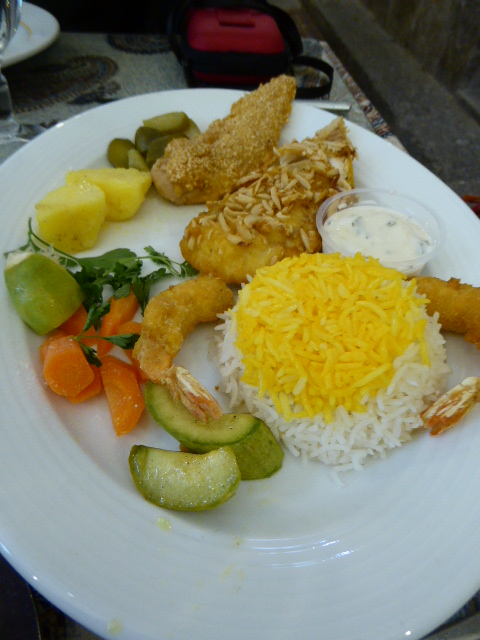
At the Romano restaurant in the evening we enjoy the usual soup, followed by a very good, fresh and plentiful salad, and the main course was lion fish from the Persian Gulf, with a sesame chicken and prawns. It was beautifully presented, as was my veggie dish which was moulded vegetables and very tasty. All good quality but huge portions. The bread was very good, the service friendly. There was fruit to finish – like a smooth skinned orange. We were not entirely sure what it was. 

attractive veggie choice at the Romano Restaurant

Lion fish at Romano Restaurant

Saturday, 17 December 2016

Iran: A Persian Odyssey -the road from Yazd to Esfahan

the protected old town around our hotel in Yazd 

layby vendor Yazd outskirts

 We leave Yazd for Esfahan – a journey of 316 km – but there will be plenty to see along the way so we should not be bored.
Lorries full of water melon are being unloaded at shops as we leave town; 
charity box in layby
there are blue and yellow charity boxes every 30 yards or so along roads – they are everywhere throughout Iran; These are placed by the Imam Khomeini Relief Foundation which was founded in 1979 to provide support for poor families and help them to regain financial stability. 
soil excavation and brick piles - local industry
Water channels or jubs along the roads in the towns are flushed through regularly or may be permanently flooded; they serve to keep temperatures lower and clear rubbish. Live chickens in pens are for sale on the outskirts of Yazd by the side of the road – (the first live chickens I have seen here – given the huge consumption of eggs and chicken meat I fear most must be reared indoors in factory farm conditions?) There is the occasional field of sunflowers – and we are soon back in the desert – with camel bushes planted to stabilise the sand.
the Narin fort at Meybod
As mentioned already, the soil around here is good for bricks and tiles – and there are plenty of piles of bricks to be seen everywhere, with much evidence of soil excavation for the manufacturing process. The tiles they make are expensive and stylish for private houses and apartments.

Meybod is known for its traditional sweets especially sesame, its many caravanserai, its pigeon houses and ice houses. Here we see an ancient mud brick citadel Narin Fort, dating back to 4000 BC, which we stop and photograph. This used to guard the caravanserai and the town itself. There is 6000 BC pottery here in the Seljuk hills. This was a strong Zoroastrian centre as well as now being well known for its pottery workshops producing domestic pottery - in a riot of patterns and vivid colours.
pottery shop and blue/yellow charity collection box

Here also we have a modern pottery demonstration. It is superb to watch the skill of the expert and very funny when our own group have a go! The shop here is a good souvenir opportunity and the pottery I took home from here was well received. It is very pretty. I wish I could have bought more but the airline strict weight restrictions must have had quite a negative effect on souvenir shopping generally - especially for the heavier items such as pottery and metal plates for example. I feel very sorry for the tradesmen who must have noticed this.  
pottery demonstration


shop in caravanserai
A further twenty minutes down the road we stop at a restored caravanserai for a comfort break and another shopping opportunity. There are lovely little artisan shops here; one lady is making handbags – and there is a coffee shop – but we have our own picnic by the coach – with gorgeous little fig sweets. There is an ice house on the opposite side of the road as well as a Post Office museum, in the last of these post office stations remaining in Iran. Sadly we have no time to see this.  Some school boys out on a trip want us in their selfies! 
factory farm?

It is still another 75 miles or c. 2 hours to lunch. Everywhere we still see photos of the war martyrs.
We pass pistachio orchard, farms and what I feel sure are factory farms. We also see several old caravanserai in various states of preservation, in desert landscape surrounded by distant mountain ranges. The traffic is mostly lorries and tour buses – except on the Friday holiday, when many private cars take to the roads and travel long distances to visit the same attractions that we are being taken to.
roadside vendor
This is the least interesting part of the whole drive to date – there is mile upon mile of desert as far as the eye can see with a distant hazy mountain range. Even the farms are now very few and far between. Occasional fruit vendors display their wares of pomegranate and water melons in lay-bys. There is a camel warning sign – we do see some camels much later in our journeying but not here.  
Then at Mohamediye we visit a carpet weaving workshop. We chat to a woman who is friendly and very welcoming but clearly curious about our group. Her husband hovers behind her and she has two beautiful young children.

our carpet weaver
The carpet weaver has been doing this work since he was 8 – he didn’t go to school. His children don’t want to carry on the skill – they would rather be lorry drivers – which is very sad. All his sisters are in the same trade and his wife works similarly at home. We watch as he skilfully weaves, dresses the cloth with a soap mixture to keep the moths away, uses a fine abrasive block to smooth the cloth and carefully trims the edges with fine nail scissors. He has made all the rugs which are for display in this workshop. We buy lovely little circular rugs – beautifully made – for 700,000 rialls each or about £17 at today's rate.
underground carpet workshop - for cooler working conditions

Lunch is at the Naeen or Na'in Tourist Hotel – they were not apparently expecting us and we had a little wait for seats but this was perhaps the best lunch we have had so far – soup starter, bread which was very fresh, a very good freshly prepared veggie dish of grilled tomatoes, rice and chips with pickled cabbage -  all very tasty and nicely presented. The rest of the group had the usual rice with beef or chicken kebabs but they were also said to be very good. Grapes and bananas completed the meal.
typical farmyard
So now we are on the road again for Esfahan with another 125 km to go.
There are mountain ranges on both sides – the snow breaks at the side of the road warn of less benign weather than what we are now experiencing. There is also a warning sign for cows in the road – I never saw any on our entire trip – although again there is much beef eaten – halal of course – so it must all be factory farmed I guess?

old caravanserai
This road has several well preserved caravanserai . We pause on the journey to look at a qanat system. This was a very ingenious system of underground water channels which tapped the water from the aquifers in the mountains and guided it down to the fields for irrigation. The line of the channels can be seen above ground by way of raised earth mounds like huge ant hills on top of which are inspection hatches. Men would climb down deep into the channels beneath to maintain and regulate the flow. Sadly the area has become a dreadful litter tip for flytipping. They are best seen in the Yazd area and the Water Museum there had a very good explanatory display for this most ingenious engineering which dates back 400 years before the Romans had built their aqueducts!   
  
As we get closer to Esfahan it is getting noticeably greener – some fields are obviously well irrigated here - nowadays more often by concrete channels rather than qanats. We pass through an ugly industrial zone as we approach this most beautiful city in the world.
entrance hatch to qanat system
To our left is a large National Park where live 1500 deer, 4000 wild goat, 800 sheep – plus hyena, fox, wolves, vultures and eagles. Plenty of springs and water support the wildlife. There are very pretty little pink flowered bushes by the side of the road.
row of qanats
We are at 1650 m altitude. The city's water supply comes from 120 km away in the mountains. The river in the city is dry – there has been a 50 year drought and while people used to picnic and boat on the river they now walk on the dry river bed and the boats lie idle on the bank.
Our guide tells us that Esfahan has the reputation for being stingy – there are lots of jokes in the same vein as our Scottish jokes.
It is evening and still 23 degrees outside the coach. 
We check in at the Abbasi Hotel. It is an old caravanserai now converted to what is claimed to be the best hotel in Iran. It is easy to see why – it is hard to imagine anything else could be better. But stay in the main hotel rather than in the large modern extension blocks built behind the gardens, and in a room looking onto the courtyard rather than on to the road or you are likely to be disappointed.
sunset on arrival at Esfahan
The evening meal in the hotel is OK –hotel restaurants are not usually the best idea anywhere in the world but we need to give our wonderful driver a break after such a long day on the road. We eat in the Traditional Restaurant – I think it is very good – not all agree – they have the usual kebabs – but my veggie dish is beautifully done for me – and they have lovely sweets – Halva (a dense sticky sesame sweet with honey) and Fereni (a sort of Persian rice custard with rosewater) and a sticky honey cake. They all satisfy my very sweet tooth.
It is strange to have to remember to put on our hijab scarf just to go out on the balcony – and remember to do so to pop out for help with adapters from the amazingly helpful housekeeper across the corridor.

remember to wear your hijab!

Buying a stamp for a postcard in one of the gift shops down in the hotel reception area the assistant has to stick this on with some incredibly strong smelling glue from a tube she keeps for the purpose. One has to remember to ask for this when buying stamps everywhere.

Wednesday, 14 December 2016

Iran: A Persian Odyssey - a day in Yazd


chadors for sale in bazaar
Our guide tells us that Yazd is one of Iran's wealthier towns. Certainly we see many big quality houses as we drive through. Much new building is going on outside the old historic centre and he tells us that saunas and jacuzzis are becoming increasingly popular. And now Yazd is a stop on the main railway line between Tehran and Kerman – a journey of nearly 1000 km. Apparently 10 years ago most people used bicycles to get around. Now they own cars - and there are thousands of motor bikes on the roads, which seem to follow their own traffic rules! Few seem to have lights on at night, lane discipline seems non-existent, all-in-all it seems a free for all from my high vantage point in the coach. It all seems very busy and not pedestrian friendly. Far more women seem to be in black chadors here than in Shiraz - a very conventional society.
abandoned bicycle shop in bazaar!

Backpacking is apparently becoming popular among local Iranians because of the high cost of travel between towns by public transport.
We pass a playground where the schoolgirls are all in black – waving black flags – I suspect this is part of their Moharram ceremonies - the commemoration of the death of the third imam Hossein, this year being held during the month of October. Yazd is the centre of these celebrations in Iran.

Much of the wealth in Yazd has come from pistachio and copper exports as well as from tourism and other fruit and vegetable. The people here are also merchants – importing/exporting with India and China. Also pilgrims stop here overnight on their way north to the shrine of Imam Reza in Mashhad. And the soil in the surrounding countryside is good for the manufacture of tiles and bricks.

the Towers of silence site
 
on the top of the Tower - note central pit
the journey up to the Tower of Silence
Our first stop of the day is at the Zoroastrian Towers of Silence (dakhmeh) – these are simply fantastic! And have the best WCs so far! (male readers may find my obsession with loos somewhat bizarre - but it has to be said that for some ladies on these trips the state of some of the traditional squats became a bit of an issue - it's much easier for you men!!) The energetic among us climb to the top of the lower tower, time not permitting a trip to the other one. At the top we reach the stone platform where until quite recently the deceased Zoroastrians would be left to the vultures and natural decay. We see the central pit or drain which would have been filled with sand, charcoal and phosphorus. This is all to prevent pollution of the earth, recognising the sanctity of earth, fire, air and water. It is important to remember that the area should be treated with the same respect which we should give to all religious and sacred spaces. Zoroastrians are now buried in a concrete chamber in the modern cemetery we can see below us - again to avoid pollution of the earth. 
Below the towers we explore the various buildings, including a water cistern with two wind towers or badgirs (see below), a mourning room, and mortuary preparation area. 
view from top of one of the Towers - modern cemetery on left in background

the faravahar zoroastrianism symbol


a script from the Yasna Zoroastrianism text
the sacred zoroastrianism flame
in Yazd
We then make our way to the Zoroastrian Fire Temple (Ateshkadeh) – the wood used to keep the sacred fire continually burning - it has been alight without interruption since 470 CE if not before - is usually walnut. It is all shielded by a glass screen to prevent pollution from our breath. Here there is a very interesting Zoroastrian museum as well – but we have woefully little time to see all that it has to offer and resort to taking lots of photos to study later – the joys of digital photography. We are reminded that when Jews went into exile this is the religion they would have met.
(more information on Zoroastrianism including what the symbol represents)

The Wind Tower, wind catcher or badgir we visit next has 4 towers - with a map of Iran set out in the paving alongside. These constructions are very clever. 

four tower badgir and water cistern with map of Iran
The badgirs rely on their design to draw and funnel a breeze into the tower for cooling purposes - this one is associated with a water cistern. Others are on residences - and may incorporate a pool or fountain below to further cool the air before it is distributed throughout the rooms - an effective and much cheaper device than the preferred modern air conditioning. They are also 

Next we see the Façade - it looks like a mosque - but it is not. Its foundations are 15th century, but it was built in the 19th century, as a viewing platform for city parades, for example at the annual Moharram ceremony. 
the Facade with Nakhl to the right
By the side of the façade stands a huge wooden Nakhl - this looks like a giant palm leaf - and during the Moharram ceremony it is covered in black and carried by 70 or so strong young men. It must be exceedingly heavy. We are to see quite a few of these, in various sizes, as we travel through the country.
We walk through a square with a large expanse of water in the middle - past some sweet shops - to the Water Museum - This is an excellent and fascinating display of the history of the water irrigation and supply systems of the area - with English translations on the captions. You will never take water for granted again after visiting this I promise.
A walk through the bazaar brings us to lunch. As we go past all the various stalls we cannot help noticing evidence of greater wealth here than in Shiraz - the quality and value of goods in the bazaar, the pots and pans, the children's furniture, all evident - and the cycle shop which has gone out of business.
Lunch is at the Silk Road Restaurant – with a good choice of drinks, in an informal and relaxed atmosphere – but the salad buffet was very basic and tired and the bread was stale. There was however a good veggie aubergine dish – and camel meat for the others! 

intricate cut tiling work in Friday Mosque

wonderful tiling of the mirab in the Friday
mosque
The Friday mosque - Masjed-e Jame - is our next port of call, founded originally 1119, over a ruined Sassanid fire temple. The 1375 mihrab is magnificent. 

After an ice cream stop we go back to our hotel for the hottest part of the day – the whole town virtually shuts down as people shut up shop and go home for siestas.
Our hotel has a traditional tea lounge where some of us enjoy the refreshment on offer. 

Suitably rested and ready for our supper, we first call by the Bagh-e Dolat Abad a garden with the tallest badgir in the world at 33m, at the former governor's pavilion. This tower collapsed in the 1960s and was rebuilt. We marvel at the coloured glass and the clever wind ventilation system in the small two storey restored pavilion which is open to the public - and can definitely feel the cool breeze created from the badgir. The gardens are beautiful - even more so as the light fails and the spotlighting at the pavilion changes through different colours - red, green, blue…


the 33m tallest badgir in the world
So on to supper at the Malek-o Tojjar Mehr Hotel  – it is quite a challenge to find through the bazaar on foot - you need a guide or a good map! There was no veggie option – only mushroom and pepper stir fry from the vegetable range – the salad was uninteresting – we didn’t like the cinnamon tea very much – bread not the freshest and others didn’t rate the meat dishes highly. But it was a lovely big atmospheric room in a traditional hotel. 


the wind funneling mechanism in roof of badgir

coloured glass window at Bagh-e
Dolat Abad


It's been a long day - with still so much to see ... tomorrow we are off to Esfahan - surely the most beautiful city in the world - and we enjoy watching traditional pottery making and carpet weaving along the way - with a chance to buy some lovely souvenirs to take home.