My book Why Religions Work explores religious tolerance issues. It could not be more relevant at the moment with the world in its present state.
This blog has concentrated recently on the wonderful pilgrimages I have been on - to the Holy Land and to Turkey and more recently to Holy Georgia , Greece "In the Steps of St Paul" , Ethiopia and most recently my experiences in Iran.

"If I was allowed another life I would go to all the places of God's Earth. What better way to worship God than to look on all his works?" from The Chains of Heaven: an Ethiopian Romance Philip Marsden

Monday, 26 October 2015

Travelling through Greece - in the Steps of St Paul - The churches of Thessaloniki

There are many Byzantine churches to enjoy in Thessaloniki - indeed here is the richest collection anywhere in Greece
We have time to see just two. 

agia sophia
We first make our way to Agia Sophia,  reminiscent of Hagia Sophia in Istanbul on which indeed it is based, with its 9th and 10th century mosaics, and one of 15 UNESCO World Heritage sites in the city. Here we are treated to the beginning of a Greek Orthodox wedding! We were taking plenty of photos between us and no one seemed to mind - but we were surely being disrespectful?
The seats in the church are extremely uncomfortable - but then worshipers are not meant to sit in them for any length of time.
wedding at Agia Sophia
We have lunch all together in a local restaurant - and very good it is too - but they really cannot cope with us all descending on them at once - and there are problems with paying afterwards. But hey go with the flow - there is no Greek word for deadline apparently.
                         
Agia sophia
From Agia Sophia we go to St Demetrius Basilica (church) or Agios Dimitrios, the site of Demetrius' martyrdom, and the largest church in Greece, with a very rich religious history and fine mosaics. The crypt of Agios Dimitrios, where according to Christian tradition Dimitrios died in AD 303, is probably the oldest surviving part of the church, and some mosaics dating from the early 7th century can be seen here. This church gives us an idea of what Basilica A would have looked like at Philippi.
By contrast with our previous experiences in Georgia and South East Turkey on previous pilgrimages, females do not generally wear headdress in church. This we are told is because during the Turkish occupation the Greek Orthodox were made to cover their heads to identify them, and this current practice is therefore a reaction to that!
Agios Dimitrios


Some in church did have their heads covered though - Mara said these would be perhaps Russian Orthodox, therefore they are showing respect in their own way.
There is a rare mosaic of a dead Jesus Christ - a symbolic of hopelessness.

How do I feel in here? We listen to the beginning of Paul's first letter to the Thessalonians, one of his earliest written letters, which he wrote to strengthen and encourage the young church here, and we see the relics of St Demetrius. The mosaics and icons are all very beautiful and there are lots of locals crossing themselves three times in front of everything and kissing icons. In fact many people here make the sign of the cross three times every time they pass a church as a sign of respect. In spite of all of this I do not find this a "thin" or very spiritual place at all.

Agios Dimitrios
Perhaps I am in spiritual overload. We are all certainly very weary and ready to check in to our hotel. There is a Greek man who clearly feels as we do - slumped fast asleep in the church head lolled against a pillar. On our way through the city to our hotel I see a group of students at a busy street corner in a very small green space - cooking a BBQ and having a small party!! And a dust cart working on a Sunday!

Agios Dimitrios
So to the hotel to check in at 4pm for just one night - we are all very glad to get to our rooms - but first we are warned by Andrew that we must not expect the ambiance and quality of our accommodation in Kavala. He was right! The Holiday Inn is very acceptable but certainly not up to the standards of that chain elsewhere as I remember them from my business days - but hey we are in Greece and it has more than its fair share of problems at the moment so let's not be too critical. 

Agios Dimitrios - some of the wonderful mosaics
And the hotel cannot really compete head-on with the wonderful waterside setting of our hotel in Kavala. This hotel has also clearly had its own difficulties. I read that not so long ago it suffered from an influx of Libyan refugees. Those poor people - there seems to be a family group "squatting" on the street corner below my balcony with their few possessions in bags of all description. So much suffering - and we quibble over the niggling defects in our hotel rooms.
Pray for refugees and the homeless everywhere - pray for solutions to the great political and social problems that cause such unhappiness and displacement in so many parts of the world.

And our greatest suffering at the moment beyond small gripes about the hotel is from information overload - so much to absorb, all so interesting.
I for one am still finding it difficult to get into the pilgrim mode; I still feel more of a tourist than a pilgrim, although the chanting in the church at the Orthodox wedding (which we "gate-crashed") touched a spiritual spot with some of us.
Agios Dimitrios wonderful mosaics
We finish the evening as usual with Compline - Mark tells us that Paul would have been influenced by the Stoics - and that Acts is not always a strictly accurate historical record - although Luke is known for accuracy and detail - but in the end meaning is what counts. I was so tired after Compline I tried to open my room door with my credit card instead of the bit of plastic which served as a key!


Today we hear the news that the latest negotiations with Greece and the EU have failed - this poor country - how will it end? And poor Georgia - the destination of our wonderful pilgrimage in 2014 - have just declared a national day of mourning over lives lost when the River Vere in Tbilisi burst its banks on Saturday night and flooded large areas of the city, including the city zoo. 
carpets in Thessaloniki
Many are homeless and animals, many dangerous, wander the streets. It is surreal to see pictures of lions and tigers in the streets, a hippo looking bemused, a bear clinging to the side of a building on an air conditioning unit! So sad that many had to be shot. We pray for Georgia, Tbilisi and our lovely guide Maka who accompanied us on that Georgian trip, and are so happy that she is OK - the wonders of instant communication on Facebook. 

Friday, 23 October 2015

Travelling through Greece - in the Steps of St Paul - Thessaloniki

sunrise in Kavala
Another lovely day has dawned. The fishing boats have left harbour by the time I awake - the sea is still and shimmering in the pink hue of dawn before the sun is fully risen. After an early breakfast we all make sure that our own bags have been placed on board and so we are off again in the coach bound for Thessaloniki, retracing our steps of the day we arrived and once again following in the steps of St Paul

Not much survives here from the 1st century BC but not only has it always been a thriving seaport, it is an important city for the spreading of the Christian gospel - there was a large Jewish community here and Paul preached several times at the synagogue albeit with little success, but many pagans and women were open to his message, some taking it so literally that they ceased work as they waited for the second coming, understood to be imminent. But he thereby also infuriated many Jews, who mobbed Jason's house where the apostles were lodging. So Paul and Silas set off once more this time for Beria. (Acts 16:11-17:14)

Much of the highway we are following from Kavala to Thessaloniki is easy on the eye - with plenty of pink Oleander, tall cypress trees and dramatic rock faces interspersed with woodland and agricultural tracts of land.

We cross the Strymonas River near to the city of Amphipolis, an important city for Philip II - this very fertile area of Macedonia was much fought over. Paul, Silas and Timothy used this as a staging post on their way west to Thessaloniki from Kavala. 
on the seafront at Thessaloniki
We do not have time to detour to see the Lion of Amphipolis, reassembled from 4th century fragments and guarding the mouth of the river. It is quite probable that the apostles saw and appreciated the splendid mane and glaring eyes of this huge statue. Amphipolis made headlines recently with the discovery of a huge funeral monument - to a woman - who could be Alexander the Great's mother Olympias so there is obviously a  huge interest. But there is also controversy and uncertainty as the research continues. There is a superb website where full analysis is available with 3D and interactive representations.


the White Tower
The modern service areas on this new road are superb. At our comfort stop today along the road we enjoy great coffee overlooking the Aegean Sea - and no queues for the loo either! We see storks flying over the Volvi lake - this is good luck for Greeks. Suddenly a loud bang - the lorry we are about to overtake blows a tyre - lots of dust and debris fly up - our driver skilfully avoids a more serious mishap. Few seem to wear seat belts here - even young children.

Workers are hand tending grapes, small herds of cows are seen but they are few and far between, a man kneeling in his field waves to us - he is planting something, but I cannot see what? A solitary manual job but he is clearly happy. Grain is being harvested - there are beautiful red poppies among the oats or barley. Nearer to Thessaloniki farming is on a larger scale. There is a large American Genetics factory . Here is not the forum for me to delve deeper into my own concerns re genetic modification if that is what they do. Then we see lots of closed down industrial units on industrial estates on the outskirts of the city. It all seems very sad, looking for all the world as if the owners just locked up one night and walked away from their failed businesses leaving vehicles to seemingly rot away in the yards.

up at citadel above Thessaloniki
So we arrive. I love the way Mara our guide pronounces Thessaloniki, with emphasis on the "al" and the "iki"! 

First we have a brief photo stop down on the port front, to see the imposing White Tower, and statue of Alexander the Great. We stroll down to the water's edge - it is very pleasantly warm at 11.30 in the morning and there are plenty of families strolling and relaxed - in spite of all their troubles - as Mara puts it: "how unhappy can you be in this sunshine?"
Then we drive up to Ano Polis, the highest point, to the Acropolis and what remains of the city walls - just 8km. There are panoramic views up here and on a clear day Mount Olympus can be seen more than 62 miles away.

We can see churches everywhere here.
Agia Sophia - wedding in progress
In 1917 seventy percent of the old city was destroyed by a great fire starting in a kitchen, destroying much of the Jewish quarters, which gave the city planners the opportunity to come up with a chance to redesign the layout.
Up at the citadel we have a short reading (Philippians1:27-30, Paul urging the young church in Philippi not to be intimidated by their opponents) and we reflect on "turning the world upside down" - and how the residents here must also have felt about Paul's visit. We sing the hymn: "City of God, how broad and far Outspread thy walls sublime!" and have a short prayer.
St Demetrius Basilica 
On our way through the town we see the new construction of the metro underground in progress - it is taking a long time Mara tells us because of cost, budget cuts and austerity measures, and archaeological discoveries which intervene - this will bring huge improvement to the city once completed and it is popular with students.
Taxis in Kavala were orange and white - here they are blue and white - in Athens they will be yellow - different cities had different colours - you knew where you were by the colour! Colours still stick although no longer obliged by regulation.
There is so much Graffiti - Mara says this is mostly about football and not political - but surely much elsewhere is political?

The condition of many houses seems appalling - even when occupied! This is because ownership is often not clear - they could have been lived in by Armenians, Jews, Muslims we are told - who have moved out and they then get very rundown. It is of course difficult to sort out ownership without deeds but the Greeks are trying to sort this out. 
Now it is time to visit some of the important churches here...Agia Sophia and St Demetrius Basilica - described next...

Tuesday, 20 October 2015

Travelling through Greece - in the Steps of St Paul - back in Kavala


Fire breaks zig-zag crazily down through the forests - fire must be a real hazard here in such searing temperatures and tinder dry vegetation. It is a big asparagus growing area - we see the fields on our way back to Kavala - bright orange pots are for sale at the roadside - all one price - 5 Euro. Allotments look very much like mine at home - complete with scarecrows. We pass remnants of the original Via Egnatia - and plenty of beehives - plus many little road side shrines - commemorating victims of road accidents. We visited Philippi this morning and have the rest of the day free in Kavala to have lunch and explore further.We see plenty of 1920s refugee accommodation lining the streets coming down into old city - contrasting sharply with the stunning views of the port laid out below us.
beehives
 Barley is being grown in quantity for the local Fix beer - which is very good - and is now building up its own export business. Thinking of beer, it is lunch time. There are plenty of water front tavernas plying their trade. The appetizers are all huge and it is obviously expected that a variety of appetizers are ordered and shared between a group - that is clearly the way to do it - like Georgia and Jerusalem and Turkey on previous pilgrimages. The double headed eagle by the port is symbol of the Byzantine empire.


locals enjoying the Kavala beach
Kavala beach
After lunch I take myself off to explore the coast to the west of the hotel - I shared my breakfast table this morning with a lady who is staying in the hotel while she visits a friend in the town and I mistook her on the first morning for a member of our group. She has told me that there is a swimming beach further round from the port, where the locals play and swim and I'm off to find it. It is quite a walk, given the afternoon heat. I go through the incredible aftermath of the Saturday street market - rubbish galore, but all being meticulously swept up by two men with nothing more than two small besom type brooms. Tomorrow there will be no trace left and all will be clean and tidy again. But as I leave the old town and port and approach the beach side promenade there is a dramatic change. The prom is but a shadow of its former glory - gardens neglected and everything including three changing cubicles on the beach itself so run down, with graffiti just about everywhere. The sand is very gritty but the sea is certainly not cold and local families are out in force enjoying themselves all along the beach. Paddling and swimming in the sea and enjoying the sand is free entertainment where financial worries can be put aside for a while.
interesting art/graffiti
Walking back to the hotel through the town itself it is suddenly eerily deserted. Most of the shops seem to be shuttered for the siesta and there appears to be a storm brewing. The atmosphere has become very heavy and thick black clouds are visible in the distance. Near the back entrance to the hotel I come upon a plinth commemorating Alexander the Great. An elderly Greek man comes up to me and starts gesticulating wildly. Have I done something wrong? But he seems friendly and after many smiles and waving of arms I understand that he is simply telling me what a very great man Alexander the Great was.

Alexander III of Macedon, commonly known as Alexander the Great, was a King of the Ancient Greek kingdom of Macedon and a member of the Argead dynasty. July 356 BC to 323 BC, His father was Philip II of Macedon, his mother Olympias. By the age of thirty he had created one of the largest empires of the ancient world, a new Hellenistic civilization and features prominently in the history and myth of Greek and non Greek cultures. Along with his teacher Aristotle he is often thought of as one of the most influential people of all time.

Enticing cake shop Kavala

On the side of the statue as I walk around it I see a plaque recording the oath which Alexander the Great gave at Opis in 324 BC, just one year before he died, at a banquet before 9,000 Greek and Asian officers. Below is not perhaps quite the exact translation recorded in Kavala - but it's close. Please read it - oh if only!

Alexander the Great Plinth Kavala
“It is my wish, now that wars are coming to an end, that you should all be happy in peace. From now on, let all mortals live as one people, in fellowship, for the good of all. See the whole world as your homeland, with laws common to all, where the best will govern regardless of their race. Unlike the narrow -minded, I make no distinction between Greeks and barbarians. The origin of citizens, or the race into which they were born, is of no concern to me. I have only one criterion by which to distinguish their virtue. For me, any good foreigner is a Greek and any bad Greek is worse than a barbarian. If disputes ever occur among you, you will not resort to weapons but will solve them in peace. If need be, I shall arbitrate between you. See God not as an autocratic despot, but as the common father of all and thus your conduct will be like the lives of brothers within the same family. I on my part, see you all as equal, whether you are white or dark-skinned. And I should like you not simply to be subjects of my commonwealth, but members of it, partners of it. To the best of my ability, I shall strive to do what I have promised. Keep as a symbol of love this oath which we have taken tonight with our libations”.

the double headed eagle at Kavala Port
The threat of storm has come to nothing. By 6 pm the harbour is bustling once again with life and activity in the tavernas, the economy helped no doubt by the very large ship in port for the night - a Hellenic Seaways liner or ferry. Many passengers offload here, with their assortment of baggage, some probably arriving home after trips to who knows where, others on the tourist trail. The roads have suddenly become very busy indeed, and where casual jay walking was the order of the day earlier on, now I have to use the lights to cross safely. I see an elderly man with a very old push chair of the simple folding type I used for my sons all those many years ago. But there is no child in this buggy. It is full of garlic bulbs, held together in ropes reminiscent of the way I have seen the French carry them on their bicycle handle bars. Here the Greek is pushing his wares from restaurant to restaurant hoping for sales before the busy evening restaurant trade.

Tomorrow we say goodbye to Kavala and continue to Thessaloniki...in the Steps of St Paul...

Saturday, 17 October 2015

Travelling through Greece - In the Steps of St Paul - Philippi and Lydia

Celebrating Eucharist at Lydia

 This morning we are set for Philippi, the first city in Europe visited by St Paul and the city where he and Silas were imprisoned, as told in Acts 16 11-40. The church of Philippi, the first Christian Church in Europe, was perhaps the most supportive of all to Paul (Paul's Letter to the Philippians 4) and he always held a special affection for them.
The Lydia baptistry
We will also visit the stream by the village of Lydia, where a shrine has been built commemorating the baptism of Lydia of Thyatira (in Asia Minor, known for its purple cloth) the first recorded baptism in Europe. Here in the open air down by the river we celebrate a group Eucharist, and renew our baptismal vows, the background noisy rush of the water in stark contrast to the solemnity of the occasion and the dainty damsel fly and the seed heads floating down on the ever so slight breeze.
Inside the Baptistry at Lydia
inside the baptistry at Lydia
On the coach we learn something of the history of Baptism in the early church. The St Lydia baptistery attracted adults from communist countries to be baptized as Christians in the 1990s.

In the Greek Orthodox church the godparents give the baby to the priest who totally immerses the child. 

St Nicholas Church Kavala 
But first we briefly visited the church of St Nicholas in Kavala, with its mosaic and the supposed post where Paul may have tied up his boat on arrival in Kavala. According to tradition, a mark on one of the ancient pillars is supposed to be Apostle Paul’s footprint, left there from the time that he first visited Macedonia.


Finding the shade at Philippi!
 From Lydia's shrine we make our way to  Philippi, then capital of this region, founded 360 BC, fortified and named by Philip II of Macedon, father of Alexander the Great. Gold mining in the area would have enabled the accumulation of wealth and the spread of the civilization here and this potential was not lost on Philip II.
mosaic floor above Macedonian tomb
at Philippi
the theatre at Philippi
Philippi on the Egnatian road
Then in 42 BC after the murder of Julius Caesar, two armies met at Philippi. The forces of Brutus and Cassius, both involved in Caesar's murder, met those of Mark Anthony and Octavian (who became Augustus, founder of the Roman Empire and its first Emperor, ruling from 27 BC until his death in 14 AD) - who won the great battle, marking the start of a new era with Philippi as a Roman colony. Paul's later visit to Philippi (Acts 16: 11-40) would have found a thoroughly Roman and important city - the first main stop on the Egnatian Way from Asia to the Adriatic
part of a Basilica Philippi
Philippi Basilicas beyond the forum
And so Philippi was the seed bed not only of the Roman Empire, but of the Christian church in Europe. 
The excavated ruins at Philippi expose the foundations of three great basilicas as well as a magnificent forum and fine theatre. 


Paul's prison cell
Philippi is hot! The shadows are black from the fierce overhead sun. Many scurry from one tiny patch of shade to the next, afforded only by the wider pillars. But the site is very well organised to cope with the tourist crowds, and is kept amazingly clean and litter free- oh how other sites in other countries could follow this example.

Roman toilet!
The baptised Lydia gave hospitality to Paul and Silas and enabled the missionaries to form a thriving Christian community here in Philippi
Here they also exorcised a slave girl, for which they were beaten and imprisoned. They escape during an earthquake - and the jailer and his family were converted and baptised to the faith. We see the prison ruins where Paul is said to have been confined.

Roman game in the pavement
Of course we cannot always know the precise locations of some biblical events and some are speculative from best information available, but it is important for us to be able to centre these events with specific places to make for more meaningful commemoration.

Next post I return to Kavala before we head for Thessaloniki...

Wednesday, 14 October 2015

Travelling through Greece In the Steps of St Paul - Kavala


Lake Koronia
The journey from Thessaloniki airport to Kavala is scenic and pretty, pink and white Oleander lining much of the main road, and we pass through olive groves and coniferous woodlands. There are election posters everywhere and the inevitable roadside litter, although it has to be said that this seems far less of a problem here than, sad to say, either in beautiful Caucasian Georgia or indeed in the UK where our litter problem is shameful.
The castle above the town
We are heading out Eastwards on the main road which was supposed to have been finished for the 2004 Olympics. It was not: apparently rare local brown bears, archaeological treasures and the mountainous terrain all conspired against timely completion. We drive alongside two vast expanses of water, the freshwater Lake Koronia and Lake Volvi. This is an important area for passage and overwintering birds. Water pollution is a problem and the area has some protection status. 

We are told that the Greeks here grow a little of everything; a few chickens, a couple of cows, some sheep, goats, pigs - a sharp contrast to the supposed greater efficiency of large-scale single crop farming which is being promoted.

the castle and port at night
As we view the island of Mt Athos to our right, in the shimmering Aegean Sea, we learn about the monks here who  inhabit this oldest surviving monastery in the world, where a wealth of unimaginable treasures is preserved for those who follow the monastic life here, other male workers and those few others who are privileged to be given permission to visit, for pilgrimage or study. Access is severely limited and women are never allowed, not, it seems, even cows or chickens! Boat trips can be taken to have a look at the monastery from a respectful distance.
Bright orange roofs on glistening white-washed houses tumble down to the shore at Vrasna. The road then climbs away from the sea again, through large areas of olive groves.  
castle and cruise liner
Suitably refreshed at a service area where we sample the local almond cake delicacy,  courtesy of Mara, we continue through a road tunnel and out again down to the lowlands approaching Kavala. The Island of Thasos is in front of us in the bay, famous for its snow white marble, mostly exported to the Emirates and Germany, and which claims to be even more translucent than the Italian white marble.

Kavala is charming - the old city sits on a peninsular topped by a castle and the acropolis. The Kamares, or "arches", are the trademark of Kavala. A listed monument, this is actually an aqueduct built in 1550 by the Sultan Suleiman II, the Magnificent. It was repaired in the 19th century by Mehmet Ali to serve the water supply needs of the City.
fishermen mend their nets and share the day's gossip
Brooding over the whole port today as we arrive is a massive Hellenic Seaways cruise liner - this is a popular tourist port of call for obvious reasons.
Kavala was also the birthplace of Muhammad Ali, founder of the dynasty which ruled Egypt in the 19th and early 20th century, and his house can be seen in the square just behind our waterfront hotel.

The town owes its prosperity to the tobacco industry, started here at the beginning of the 19th century, and there is a Tobacco Museum which recalls the industry's rise and subsequent decline in the area in the early 20th century. Tobacco used to be a big crop generally here in Macedonia - until the advice was given to start growing sunflowers for the oil. 
solar panels - many along the way

Now a different style of farming is evident - Solar panel farms are cropping up everywhere.

Kavala at night
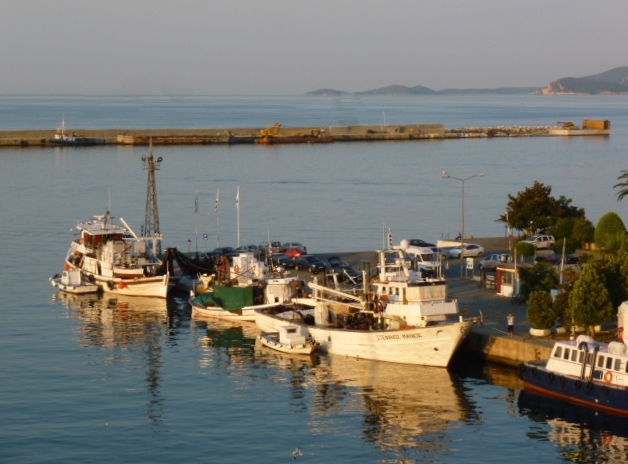
We arrive at our hotel in Kavala in the early evening. It is in the old town fronting the port and after a quick check in and unpacking of essentials there is time for a stroll around this delightful old town. There are tranquil scenes of fishermen sitting around mending their nets, while no doubt sharing the gossip of the day. A row of suntanned women, mostly dressed in black, sit on a bench in the shade, the sun still fierce in spite of the hour. Reflections ripple on the water as just below the surface small fish fry are taking advantage of the day's accumulated detritus from the returning fishing boats. Seagulls are also trying their luck. Houses scramble up the hillside to the citadel. After saying our evening devotional Compline with the group, I sit on my balcony looking down upon the busyness of the cafes and restaurants below which have suddenly come alive. It is lively in a restrained kind of way - and the air is pleasantly warm to sit out. Hard to imagine that winters here can be harsh.

Sunday, 11 October 2015

Travelling through Greece - in the steps of St Paul

This is my own very personal perspective of a journey through Greece.
It is also my story of a pilgrimage. A pilgrimage from Southwark Diocese led by the Very Revd. Andrew Nunn and organised by McCabe Pilgrimages.

But what is a pilgrimage if not a journey? Of discovery, getting to know ourselves better, getting to know others better, and in the case of this party from Southwark Diocese, getting to better understand our relationship with God. But my story here is not just about the religion. It's very much a travelogue for this beautiful area as well. We shall be visiting Kavala, Philippi, Thessalonika, Berea, the Meteora Monasteries, Delphi, Athens and Corinth and more - an exciting prospect which I shall write about over the next few weeks.
It's 4.40am on 12th June 2015 at Zone A North Terminal Gatwick and thirty four bleary eyed pilgrims are gathering for a trip to Greece, to follow In the Steps of St Paul, on his second great missionary journey. 
Greece is for many the cradle of Western civilization and democracy. It has given us so much. Now the country needs our prayers and understanding as it struggles with its current financial crisis, whatever our individual views of the causes and solutions.
Lake Volvi
Summer had barely started in the UK - flaming June it most certainly had not been so far, until the day before we travelled, when the mercury at last hit a respectable 23 degrees - good but hardly sufficient training for the heat we can expect in the week to come.
Andy's Coach
service area Greek style
It is good to see Rosemary Nutt from McCabe checking in to travel with us. Many of us know her well from previous pilgrimages, notably for me in Georgia and before then the Holy Land, both covered in my previous blogs.
Indeed it was the trip to the Holy Land which sowed within me my passion for pilgrimage.
As we make ourselves comfortable for the 3 hour flight, I settle down to read a draft copy of Dr Mark Vernon's "The Idler Guide to Ancient Philosophy" which promises to be not only an introduction to Greek Philosophy but also a link with the Greece that St Paul would have experienced on his journey and the culture into which Jesus Christ came into the world. It proves to be a fascinating companion for our journey. Mark is travelling with us and continues to give us the benefits of his wisdom in this field throughout the trip, often helping to while away the longer road trips. Much of this is recorded in the Dean's own blog so I will not attempt to repeat any of it here - but I promise it is fascinating stuff. Mark shows us that philosophy is not stuffy. He soon shows us that we are all philosophers.

Oleander at service area
We head up into low cloud which clears over Belgium to reveal a green patchwork of fields and woods, contrasting sharply with the parched brown landscape as we approach Greece, where we are told it is 28 degrees and rising. Hooray!
Kavala awaits us
We have a snack on the plane - the vegetarian option simply means that the ham has been removed from the ham and cheese croissant! Frugal!
The scenery is beautiful as we bank sharply to land, over an azure blue sea dotted with all kinds of boats, and many Greek islands - apparently there are 6000 or so, only a fraction of which are known to travellers.

Tranquility at Kavala
The flight is smooth in all respects, and on arrival at Thessaloniki we are soon settled comfortably into our air conditioned coach being looked after by our attentive Athenian guide Mara (short for Maria - a family name passed down through several generations) and our careful driver Tassus, as we make for Kavala 160 km to the North East,
Kavala was previously the ancient port of Neapolis where Paul landed arriving from Troas on his way to Philippi, travelling along the Via Egnatia linking the Aegean and Adriatic Seas. 600 km long, this great Roman road was a vital artery for the Romans, used by merchants, generals and proconsuls alike as they travelled to and from Rome via the Via Appia to the Adriatic and thence to Neapolis and the Via Egnatia.
It seems fitting that the Good News of the Gospel of Jesus Christ should follow the same route on its early journey into Europe.

Tomorrow we shall visit Philippi and Lydia... Meanwhile we enjoy our stay at the Galaxy Hotel on the waterfront at Kavala.